Quilt No.659CNH - Crow's Nest and District Historical Society

Crow's Nest and District Historical Society
Owner: 
Crow's Nest and District Historical Society
Location: 
QLD South West
Maker
Maker: 
Unknown
Made in
AUSTRALIA QLD
Date: 
1901 - 1920
Description: 
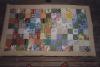
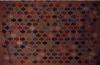
Reversible quilt with an all over pattern of squares in printed cottons including cretonnes. Originally longer but it was shortened in 1980 by a member of the Crow's Nest and District Historical Society.
1702 x 1220mm
History: 

The maker is unknown but the quilt is thought to have been made before 1920. It was part of the contents of 'Carbethon',the Just family home, when it was donated to the Crow's Nest & District Historical Society in 1978. The Just brothers remembered using the quilt on the verandah of this Queenslander. It is now displayed at the Carbethon Folk Museum and Pioneer Village.

Story: 

" 'Carbethon' was the home of Mr. and Mrs.M.E.W.Just, Haden. It was donated to the Crow's Nest Historical Society by their eldest daughter Doris, and her husband, Claude Walker.
Claude's grandfather, Edwin Loveday built the house in the late 1880s. It was the first sawn timber dwelling in Plainby. In 1909, Claude's parents, Lily Loveday and Alfred Walker were wed in the house. After World War 1 the Lovedays sold their property to their neighbour O.C.Williams. He sold the house for removal to William Just, who rebuilt it next to the Haden State School where it stool for fifty years. He and his wife Freda (nee Garrett) reared 15 children in it. Mrs. Just named it 'Carbethon' (pronounced Car-BETH-on) an aboriginal word thought to mean 'Happy Home'.
After much voluntary work by the small Historical Society, the house was moved to Crow's Nest in 1978 and opened as a Folk Museum with a 'Grandma's Day' in September 1979."
[Extract 'Carbethon Folk Museum and Pioneer Village' brochure]

Related Quilts:
Tasmanian Museum and Art Gallery
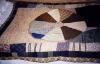
Machine sewn reversible quilt. Side 1 is rectangles of men's suiting samples in mainly grey, navy and black, stripes and self patterns. Side 2 is men's suiting samples but also includes woollen rectangular pieces in plain blue and deep pink. There is a hand sewn binding of fine orange-brown wool. The padding is hessian and cotton.
1460 x 1100mm
Fiona Gavens
Hexagon quilt constructed over papers; all seams oversewn with featherstitch embroidery. Materials are vyella and clydella scraps from childhood dresses of the maker's first four children, augmented with scraps from a dressmaker and a book of samples. There is no padding; backing is plain, pale blue, brushed cotton.
2200 x 1720 mm.
Powerhouse Museum
"A tied patchwork wagga quilt made from swatches of men's wool suiting fabrics in blue/grey and pink/brown tonings. Rectangular swatches have been cut in half diagonally, and the resulting right-angled triangles paired to form larger equilateral triangles which alternate dark with light across the field. The quilt has been machine and hand pieced, then machined in vertical stripes.
The centre field is bounded by two strip-pieced borders at top and bottom, and three down each side. These are sewn from rectangles, using light pink/brown tones for the inner border and darker colours for the outer borders. The quilt is padded and backed and the side seams are secured with black herringbone stitch. The three layers are tied together invisibly with lazy daisy stitches in black cotton from the back." [PHM] The padding is a wool blanket and the backing is two pieces of cream twill cotton.
2030 x 1440mm
Beryl Warne
The quilt's construction is cotton patches about 170mm square joined in strips and then the strips joined. The border and backing are pale lemon coloured cotton lawn. The padding is an old woollen blanket. There is ric-rac braid around the border of the top.
2180 x 1420mm
National Gallery of Australia
" Reversible patchwork quilt of woollen suiting/upholstery fabrics in khaki, greys, blues and browns. Both sides have different designs. The front of the quilt has 13 rows of 12 vertical rectangles flanked on either side by a column of 22 horizontal rectangles. The reverse has a more interesting and complex design of small and very large rectangles, squares and triangles; with khaki contrasting with the duller greys and blues. The patchwork layers are joined at the edges with machine stitching and the quilt is machine quilted along 3 horizontal lines following joins in the patchwork; therefore not being totally straight. These lines are more noticeable on the reverse. The reverse face has been on display at the NGA." [NGA] There is a cotton blanket used as padding. 2054 x 1451mm
Gillian Sullivan
Quilt made of 9120 very small Suffolk Puffs, each one about the size of a 20 cent piece. "Each piece backed and the front of it drawn up like a reticule. It was not backed and was rather fragile, so I backed it on to a sheet, as it was heavy and in danger of tearing when lifted." [Gillian Sullivan]
2360 x 2230 mm