
Quilt No.766PHM - Powerhouse Museum
Owner:
Powerhouse Museum
Location:
NSW Sydney
Maker
Maker:
Unknown
Made in
ENGLAND
Patterms
Date:
pre 1850
Description:
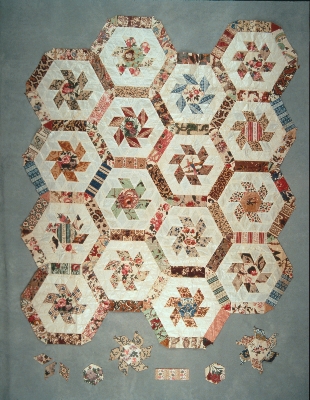
"An unfinished quilt in traditional 'Pinwheel' pattern, handsewn with linen thread using the English method. The quilt is composed of sixteen large hexagonal blocks made up of square, diamond and triangular patches around a central hexagon. The central motifs and outer borders are of block printed floral and geometric patterned glazed cotton chintz, with plain white cotton chintz as the background. The patches still have their original paper templates in place; many of these are covered with handwritten numbers and are perhaps from a school exercise book. A collection of templates,...
History:
"The quilt was given to the museum in 1987 by Mr and Mrs N D Cook of Bowral, NSW. The grandparents of both Mr and Mrs Cook came to Australia from England, and they are not sure which side of the family brought the quilt here with them." [PHM]
Story:
"The fabrics from which the quilt was made are of different dates, the earliest probably dating to the late 1700s, and were probably collected over several years. They are in new condition which suggests the maker was well to do and patchwork a pleasant way to pass the time rather than an economic necessity. The quilt was probably made in England around 1840 and brought to Australia some time after that." [PHM]
Related Quilts:
The top is mainly squares of flannel machined together with patches of dress materials stitched randomly on top. There is no padding and the backing is calico. The top and backing are held together by a binding only. It is one of a pair.
2010 x 1680mm
2010 x 1680mm
Patchwork quilt has a centre of a square within a square, with rows of scraps added around it. The scraps are mainly cotton shirting fabrics and are cut in different sizes and shapes. The two long sides have a narrow red edging folded from the back. The other two sides have been 'bagged'. Filling is an unusual weave thought to be wool. Backing is a pink, red and beige floral cotton.
2080 x 1650mm
2080 x 1650mm
Repeat block in Ohio star pattern. Wide border of triangles, pieced blocks and stripes. Stars are in greens, pinks, mauves (all now very faded) and white. Wreath quilting in squares with smaller wreath quilting in triangles. There is padding and the backing is a poly/cotton sheet. 2500 x 2450mm
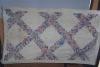
Cotton quilt, machine sewn and hand quilted. Pattern similar to Double Irish Chain. The background is white and the small squares mainly patterned in pinks, blues, lilacs and greens. The backing is plain white cotton and the padding, which is lumpy, could be some type of cotton.
2057 x 1220mm
2057 x 1220mm
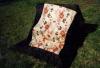
Quilt made with a rectangular centre panel of cotton fabric printed with red poppies and black flowers in a japanese style. The panel is surrounded by a wide black satin border. The backing is of black cotton, covering a previous backing of green floral cotton fabric. The padding is feathers.
1700 x 1370mm
1700 x 1370mm

Patchwork quilt of hexagon patches in a variety of colours and fabrics, including cottons, wool, lace, nylon. Edging is of yellow cotton. It is backed but there is no filling or padding.
2470 x 2100mm
2470 x 2100mm