Quilt No.1063NTSA - National Trust of Australia (SA)
National Trust of Australia (SA)
Owner: 
National Trust of Australia (SA)
Location: 
SA Country
Maker
Maker: 
Mary .Perrens
Made in
AUSTRALIA SA
Date: 
1901 - 1920
Description: 
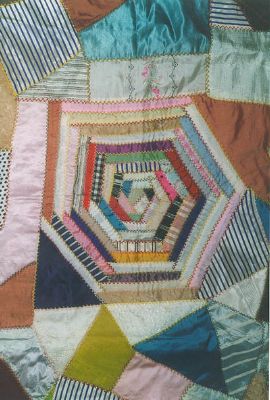
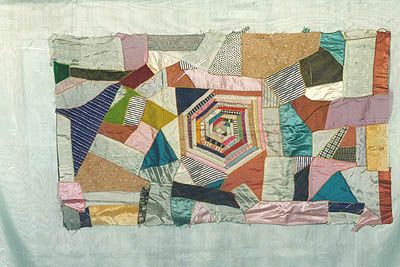
Hand stitched unfinished crazy quilt with patches placed around a centre hexagon pieced in log cabin type strips. Materials are mainly silks and satins and pieces are mounted on grey cotton material. Seams are overstitched in herringbone stitch. 1520 x 760mm
History: 

The quilt was made by Mary Perrens in South Australia c.1910. It was inherited by her daughter Miss Eva Perren following the death of her mother in 1957. Eva Perren donated it to the Jamestown National Trust museum in 1970. It is displayed in a glass cabinet at the museum.

Story: 

Mary Perren (born Mary Honeychurch) was born in England in 1875 and married in Baldina SA in 1907. Her husband was a blacksmith and railway ganger and they had three children: Ed. Phillip b. 1908, Alick John b.1912 and Eva Alice Lucy b. 1914. Mary's husband died the same year Eva was born and Mary had to leave the railway cottage in Jamestown where she had lived for some years and find work to support her family. Both Ed and Eva spent all their lives in Jamestown and their brother Alick was a school teacher.

Related Quilts:
Wangaratta Historical Society
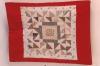
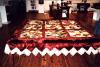
9 large blocks of crazy patchwork in silks and velvets. The blocks are divided by strips of deep ruby coloured silk. There is a wide ruby border with peaks to which is attached cream lace. The backing is beige silk. The main blocks are outlined with feather stitch in gold thread and many individual patches are outlined in fancy stitches and have embroidered motifs some of which are Australian eg centre patch has Sturt's Desert Pea flowers, parrots, wattle. There are also English flowers, Japanese motifs, flags, domestic objects and Marianne's initials. Embroidery is in a variety of threads including chenille.
2250 x 2180mm
Jean Gill
Pieced quilt featuring log cabin and tumbling block patterns. It is handsewn and has some appliqued flowers.Materials are mainly velvet with a small amount of cotton. There is no padding and the backing is cotton flannelette.
1525 x 1220mm
National Trust of Australia (WA)
Patchwork quilt in Grandmother's Flower Garden pattern, consisting of 7 patch rosettes with white 'paths'. Cotton dress and shirting materials have been used in blues, pinks, brown, turkey red and Prussian blue. The quilt is hand sewn and each hexagon is 25mm wide. The backing is cream twill cotton in three panels. There is a hand sewn binding in red/pink cotton. There is overall quilting in chevron or zigzag pattern.
2415 x 2110mm
Art Gallery of South Australia
Rectangular patchwork crazy quilt pieced in squares (3 across by 4 down), in silks and wool, with red sashing between blocks and red border, quilted. Colours are dark, with red and light blue. Embroidery includes double feather, rope, herringbone, satin, cross, sword edge, buttonhole and coral stitches, and French knots. Embroidered flowers include lily of the valley, rose, daisy, and sunflower, also butterflies. Backing is pieced in the frame style, with a large centre red square, within 10 frames or borders. Embroidered "In Most Loving Memory of My Darling 1883", "V.H.B." Hand sewn.
1900 x 1500mm
Meg Orr
All over pattern of rows of hexagons with each unit made up of 4 hexagons each 45mm. Patterned and plain materials thought to date from the 1930s including cotton and linen dress materials, synthetics and synthetic crepe. It was an unfinished top and Meg Orr, the present owner, finished it by machine stitching some of the hexagon rosettes to the red twill background and stitching on a backing. There is no padding.
1740 x 1210mm.
Joyce Lannin
A hand sewn quilt of more than 6,536 hexagon pieces in cottons, silks and polyester mix. There is a centre circular pattern of hexagons within a larger hexagon and small hexagons form larger hexagons in a random pattern on the quilt top. There is no padding and the backing is a plain fawn sheet with a floral edging in hexagons. 2880 x 2550 mm.