Quilt No.769PHM - Powerhouse Museum

Powerhouse Museum
Owner: 
Powerhouse Museum
Location: 
NSW Sydney
Maker
Maker: 
Unknown
Made in
ENGLAND
Date: 
pre 1850
Description: 
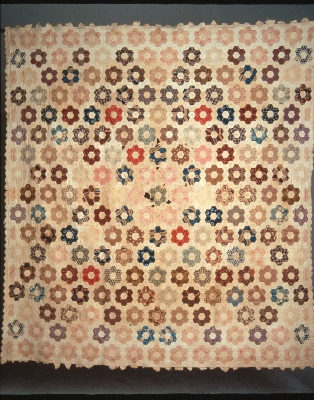
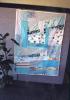
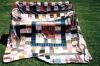
"A rectangular quilt made from hexagonal cotton patches, pieced in the traditional 'Grandmother's flower garden' design of scattered rosettes on a plain ground. The rosettes are made from six patterned hexagons around a seventh cream hexagon, which forms the flower centre. The patterned fabrics are a mix of small floral prints with some checks and geometric designs, and the colours are mainly shades of brown, blue maroon, pink and lilac. The ground fabric is plain cream. The quilt was made the English way and is hand sewn. Traces of the paper templates still remain." [PHM] There is no...
History: 

"The quilt was given to James and Emma Buttworth and family 'many years ago' by the last remaining member of the Weeks family, who brought the quilt with them from England to Australia."
"Miss Elva Buttworth gave the quilt to her neice Daphne Evans of Hamilton South, NSW and she in turn gave it to the Powerhouse Museum in 1980." [PHM]

Story: 

"Emma Buttworth was a descendant of the Matthew Boulton family (Boulton and Watt invented the steam engine and were famous silversmiths in Sheffield). She was born in Ghinni Ghinni on the Manning River in 1858. James Buttworth, whom she married in 1878, was the grandson of Sarah Rose the daughter of the first free settlers in Australia who married James Buttworth in 1812. Rose Cottage, the home of the Rose family, still stands today in Wilberforce and is the oldest timber cottage in Australia." [PHM]

Related Quilts:
Muriel Hartmann
Reused parts of hand knitted woollen jumpers patched together. Wide crocheted edge from wool unravelled from jumpers retrieved from the tip.
1905 x 1525mm
N.S.W. Parks and Wildlife Service
Double sided quilt. Side 1 has an off centre frame based on a hexagon and including triangles and squares in a concentric pattern. The borders are all small rectangles with a single strip of large rectangles at one end. Side 2 has a central patch of pieced shapes appliqued to the background. The borders are squares and rectangles many in striped shirting cotton. Side 1 has minimal quilting to the interlining but it does not go through to side 2. The padding is a thin sheet.
The circle (sometimes pieced hexagons) is common to other 'Craigmoor' quilts.

1450 x 1230mm
Art Gallery of South Australia
Frame cot quilt in cotton fabrics, the centre square in a paisley print surrounded by two plain borders or frames, then two frames pieced in alternate light and dark triangles, then a frame in a floral print. Outer border is of red fabric, longer at top and bottom to make a rectangle. No quilting. Machine sewn.
1050 x 770mm
Joan McGregor
One side of this quilt is large pieces of check and striped material surrounding a small patterned supper cloth with a border of scrap pieces. The other side is small, floral, check, spotted, striped and plain cotton pieces surrounding a tablecloth. It is machine sewn and is not quilted. The padding is an old woollen blanket.
1825 x 1625mm
Diana Cameron
Small patchwork piece possibly made from salesman's samples. There is no opening in the back so it is not a cushion cover. There is no padding. The backing is green polished cotton. There is a 40mm fringe around the edge.
520 x 520mm
Griffith Pioneer Park Museum
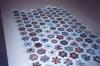
Patchwork quilt made from hexagon patches of cotton, silk, brocade, sateen and wool. Some silk patches are individually lined. Colours are mainly red, blues, purple, black, yellow and brown, with some pastels. Many silk patches have disintegrated, showing the paper templates. Quilt has a brown cotton inner lining, then a blue cotton backing, and is edged on the reverse with checked silk. Hand sewn by more than one person: one experienced sewer, one not so experienced.
1370 x 1170mm