Quilt No.787CN - Charlotte Nattey

Charlotte Nattey
Owner: 
Charlotte Nattey
Location: 
ACT
Maker
Maker: 
Nancy Millington
Made in
ENGLAND
Date: 
1921 - 1940
Description: 
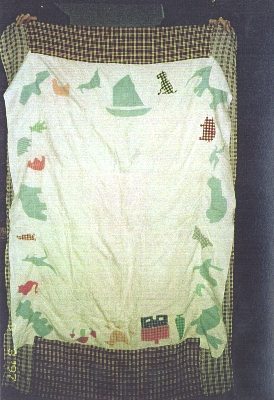
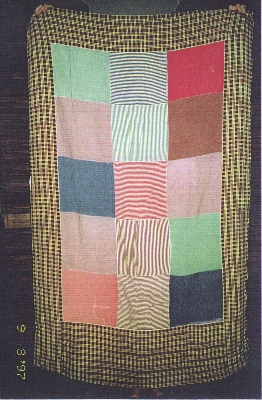
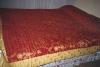
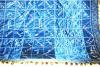
The top is a piece of checked flannelette around which is a border of simple animal shapes appliqued in blanket stitch. The backing cosists of sample squares of Moygashel linen joined in rows. The quilt was made for a playpen. There is no padding.
1630 x 1090mm
History: 

The quilt was made in England by Mrs. Nancy Millington in 1940 for her daughter Charlotte to be used in her playpen. It was later used by Charlotte's children. It is owned by Charlotte Nattey and is stored for the next generation.

Story: 

"I was born at the start of World War 2 and things became impossible to buy - this was made out of old samples from my father who was a director of Moygashel, the Irish linen manufacturer. During the war he was not called up (but was a member of the Home Guard) as his firm was used to make webbing for parachutes and belts and parachute silk etc. This was deemed an essential service. We lived north west of London as he had to go to London to work each day and this was deemed the safest area to be in.
My mother was a very elegant woman and although quite capable of doing things with her hands didn't choose to do so unless there was a need! - at this time there was a need but I doubt if she would have made a quilt at any other time! Cottage type industry just wasn't her scene: the world of high fashion and couture was the area she was happiest. In her spare time she was a keen bridge player, a freelance writer for magazines and an avid reader."
���
"In General.
It was the women in my father's family who were the quilters.
[My mother] made the wartime playpen quilt but she and her mother were more inclined to knit rather than sew. They were both university educated and highly intelligent 'blue stocking' types. Well read and fun to be with.
I sew a lot and am a fully qualified dress designer making most of my own and my daughter's clothes. I regard myself as the custodian of all the lace, embroidery, quilting, knitting etc. that has survived and am happy to share it with interested people.
I have never made a hand quilt but have started on one at present using entirely machine techniques. It probably won't last as long as a traditional quilt but it seems appropriate for the next milennium to use a computer machine and overlocker in this way."
[Charlotte Nattey 6.4.97]
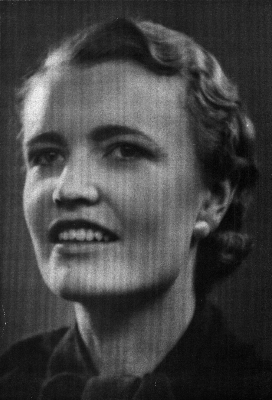
Eleanor (Nancy) Millington
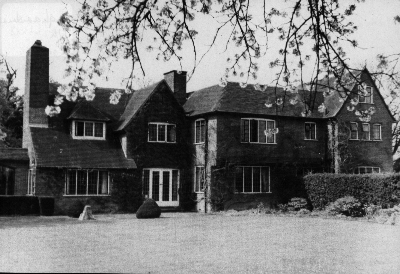
The farm in Buckinghamshire England where the quilt was used.

Related Quilts:

Yvonne Hamdorf
Wholecloth pram quilt with a top of pink cotton sateen, and the reverse is a more finely woven, ivory, fabric. All over quilting design as main feature, with stylised hearts, leaves and cross hatching. The padding is cotton batting. 870 x 660 mm.
John Tomkin
Hand stitched, cotton, appliquéd, quilt in a flower pattern on a plain background. Colours are shades of green, apricot and browns. This quilt was known as a 'Bride's Quilt'. Padding is thought to be layers of white fabric raised almost like a wadding. The backing is cotton material. 2470 x 2020 mm.
Romsey/Lancefield & Districts Historical Society
Wholecloth quilt made of royal blue satin, squares around a central panel. Seam lines are covered with a faggoting stitch. All names are embroidered in satin stitch, the central motif is hand painted. The border is quilted with a repeat scroll ing pattern in hellow thread, and edges are trimmed with a fringe of small pom-poms in burgundy, gold, blue and yellow, the colours mixed in each pom-pom. Quilt is backed with yellow satin cotton. Centre has embroidered: "Lancefield/ Presbyterian/ Sale of Gifts/ February, 1896'.
1880 x 1330mm
Kereake Wray
Wholecloth Greek quilt. "The fabric is a beautiful silk satin with a formal pattern of soft yellows and pinks on a turquoise background. Surrounding this is a 40cm wide border also of silk satin (cerise coloured). The quilt is machine pieced but hand quilted. The method of quilting is very interesting. A thick cream twist has been used and at first glance it seems that the quilt is tied as there are long pairs of stitches with gaps of about 4cm between them. However, either a long needle was used to make a pair of stitches OR each side may have been quilted separately with the needle only going half way into the wadding which is about 2 cms thick." [Kereake Wray] The padding is kapok approx 2 cm thick and the backing is deep coral pink satin. 2200 x 1960 mm.
Melinda Smith
Wholecloth cover in synthetic rayon. Centre plain, drop slightly gathered, edging border is large saw tooth appliqued pieces in flannelette, striped seersucker, crepe de chine. Materials typical of the 30s through to the 50s. The appliqued triangles are chain stitched in yellow thread which also anchors them to the backing.
2450 x 1940mm
E Shuttle
Wholecloth quilt made from orange cotton cretonne for back and front. Padding is made from old blankets stitched together. The quilt weighs 16 lb.
1423 x 1118mm