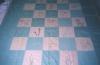
Quilt No.840AG - Annette Gero

Annette Gero
Owner: 
Annette Gero
Location: 
NSW Sydney
Maker
Maker: 
Jane Hope
Made in
ENGLAND Northumberland
Date: 
pre 1850
Description: 
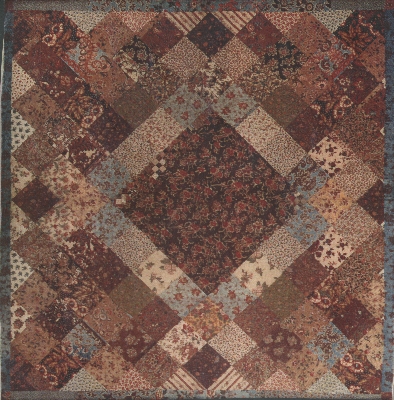
Hand pieced frame quilt with centre frame and borders of squares set on point. There is a blue patterned border. The backing is white and it is finely quilted. "The fabrics themselves are all absolutely typical of the period [1830 t0 1840] and many, if not most, of them can be found as illustrations in historical textile reference books - in this respect the quilt is virtually a book chapter in itself and has a particular value to a quilt historian. At about this period in England cottons and chintzes were being produced in great quantity and were relatively modestly priced." [Annette...
History: 

The maker was Miss Jane Temperley Hope and the quilt was made in Hexham, Northumberland, England c.1840. In 1932 it was sent to Mrs. A.E.Talbot who was related to Miss Jane Temperley Hope on the maternal side. It is now in the collection of Annette Gero.

Story: 

"The Sydney Morning Herald, Wednesday, July 20, 1932 'A Century Old Patchwork Quilt is Mass of Fine Hand Quilting and Old Fashioned Chintzes. Very proud of this marvellous patchwork quilt is Mrs.A.E.Talbot, wife of Dean Talbot. The quilt which is made of pieces of the loveliest of patterned and gaily coloured chintzes, has a plain white lining, showing an intricate and beautiful pattern worked in quilting. It was the work of one, Miss Jane Temperley Hope, in 1798-1800, who lived at Hexham, Northumberland, England, an ancestress of Mrs. Talbot's on the mother side, and has been in the family ever since. It was recently sent to her mother, Mrs. A. Vert, who has passed it on.' It was brought to Sydney in 1932. The fabrics themselves are a document of chintz available in the 1830s and 40s making this quilt an important historical record." [Annette Gero]

Related Quilts:
National Trust of Australia (WA)
Hexagon quilt in dress and shirting cottons constructed in frame style with a centre rosette of 7 patches surrounded by 4 borders of patterned hexagons alternating with cream patches. The quilt has an inner border of triangles then rows of rosettes alternating with cream patches. The outer border is triangles. There is no padding. The backing is cream linen and has had a 20th century white cotton sateen slipstitched to it.
2045 x 1940mm
Fiona Gavens
Hexagon quilt constructed over papers; all seams oversewn with featherstitch embroidery. Materials are vyella and clydella scraps from childhood dresses of the maker's first four children, augmented with scraps from a dressmaker and a book of samples. There is no padding; backing is plain, pale blue, brushed cotton.
2200 x 1720 mm.
National Trust of Australia (NSW)
Quilt of small silk and rayon rosettes of hexagons in prints and plain materials including velvet, voided velvet, chine, printed silk, brocades, taffeta, satin, crepes. Many of the materials are from Japanese kimono and wrapping silks. It is pieced over papers, one paper has a typed date '1930'. The backing is black silk satin and is turned to the front to form a border.
1695 x 1390mm
Lora Busellato
Machine pieced cotton quilt, in random design of geometric pieces. Materials used are cotton sheeting, dress fabrics, broderie anglaise, and seersucker. There is no padding, and backing is white curtain lining.
1540 x 1150 mm.
Gillian Sullivan
Quilt made of 9120 very small Suffolk Puffs, each one about the size of a 20 cent piece. "Each piece backed and the front of it drawn up like a reticule. It was not backed and was rather fragile, so I backed it on to a sheet, as it was heavy and in danger of tearing when lifted." [Gillian Sullivan]
2360 x 2230 mm
National Gallery of Australia
" A wide range of cotton fabrics have been used to make this quilt in the traditional log cabin style. The strips of the log cabin are joined by rows being hand sewn onto a small square backing fabric, each square of strips has then been hand sewn together to form the quilt. The work is backed with a sateen printed fabric decorated with paisley design. A strip of the lining trims the edge of the front face of the quilt. The lining is attached with machine stitching. There are numerous tacking stitches that remain in the front face of the quilt. There are approx 9000 pieces in the quilt, most being only 5mm in width.
The quilt is of three layers because the strips of the log cabin are attached to a backing piece, and then the quilt is lined; however it is not padded." [NGA]