Quilt No.615PWH - The Pioneer Women's Hut

Owner: 
The Pioneer Women's Hut
Location: 
NSW Riverina
Made in
AUSTRALIA NSW
Date: 
1921 - 1940
Description: 
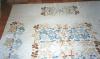
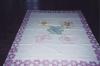
White cotton quilt of blocks with an embroidered flower in each one. The whole 'garden' is encircled by an appliqued picket fence. There is a cotton backing but no padding.
1840 x 1820mm
History: 

This quilt was made by a group of women from the Boorowa or Cowra districts NSW as a raffle to raise funds for a charity. It was raffled between 1931 and 1935 and the raffle was won by Jessie Jackson, always known as Gipsy. Her daughter Morag Faithfull donated it to The Pioneer Women's Hut. It is occasionally displayed at the museum.

Story: 

The daughter of Gipsy Jackson said the prize for the raffle included a dressed doll and so her mother thought the quilt was a doll's quilt. When the family lived in Queensland and then back in Warren NSW the raffle quilt was always used on the bed in the visitors' spare room.

Margaret Rolfe, well known Australian quilter and quilt historian, recognised the design as one from the American quilt designer, Ruby McKim*, whose designs were also published in the Adelaide Chronicle and republished in the Weekly Times newspaper in the 1930s.

Related Quilts:
Yvonne Hamdorf
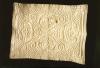
Wholecloth pram quilt with a top of pink cotton sateen, and the reverse is a more finely woven, ivory, fabric. All over quilting design as main feature, with stylised hearts, leaves and cross hatching. The padding is cotton batting. 870 x 660 mm.
John Tomkin
Hand stitched, cotton, appliquéd, quilt in a flower pattern on a plain background. Colours are shades of green, apricot and browns. This quilt was known as a 'Bride's Quilt'. Padding is thought to be layers of white fabric raised almost like a wadding. The backing is cotton material. 2470 x 2020 mm.
National Trust of Australia (SA)
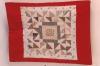
Randomly patched quilt in many different colours and fabrics. There are appliquéd shapes over many pieces including Suffolk Puffs, hearts, hexagons and other shapes. There is an embroidered inscription "A11 to S11 1829" which is thought to mean AN to SN 1829. There is no padding and the backing is white cotton.
2000 x 2200mm
Annette Gero
This domestic Wagga is two layers of woollen army blankets with the top layer in rectangles joined in rows. The backing is hessian bags that originally contained meat meal.
11650 x 1130mm
Kereake Wray
Wholecloth Greek quilt. "The fabric is a beautiful silk satin with a formal pattern of soft yellows and pinks on a turquoise background. Surrounding this is a 40cm wide border also of silk satin (cerise coloured). The quilt is machine pieced but hand quilted. The method of quilting is very interesting. A thick cream twist has been used and at first glance it seems that the quilt is tied as there are long pairs of stitches with gaps of about 4cm between them. However, either a long needle was used to make a pair of stitches OR each side may have been quilted separately with the needle only going half way into the wadding which is about 2 cms thick." [Kereake Wray] The padding is kapok approx 2 cm thick and the backing is deep coral pink satin. 2200 x 1960 mm.
The Embroiderers' Guild of S.A.Inc Museum
Wholecloth quilt in white cotton voile with alternating designs of Australian wildflowers worked in multi coloured cottons and shadow work. It is backed with yellow voile. There is no padding.
2010 x 1910mm