
Quilt No.648NG - Norma Gilchrist

Description:
Quilt entirely made of hexagons joined to make 'flowers', 6 hexagons form the petals and one in the centre. The quilt is all cotton in a wide variety of colours in plains, checks and florals. The hexagons are all hand stitched using stranded cotton. There is a plain blue border of headcloth machined around the edge to the backing material. It is not quilted The materials were almost all from the scrap bag. Brown paper templates were used. This arrangement of hexagons is one variation of a pattern commonly called 'Grandmother's Flower Garden'.
2040 x 1720mm
2040 x 1720mm
History:
The quilt was made by Sylvia Schliebs and her daughter Norma in the Temora district NSW c.1845. It is now owned by Norma (Gilchrist). It is still used.
Story:
Sylvia Schliebs (1898-1995) and her daughter Norma sewed this quilt in the wintertime after tea at night. They lived on a mixed farm, 'Spring Valley', and Sylvia's life was like that of many farmers' wives with farm jobs to do including milking cows and looking after many chooks. She sold butter and eggs and bunches of violets and made most of her own and Norma's clothes. She was thrifty, practical and a good cook.

Sylvia Violet Schliebs c.1946
Related Quilts:
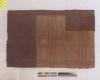
This domestic Wagga is two layers of woollen army blankets with the top layer in rectangles joined in rows. The backing is hessian bags that originally contained meat meal.
11650 x 1130mm
11650 x 1130mm
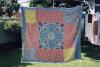
One side of this quilt is large pieces of check and striped material surrounding a small patterned supper cloth with a border of scrap pieces. The other side is small, floral, check, spotted, striped and plain cotton pieces surrounding a tablecloth. It is machine sewn and is not quilted. The padding is an old woollen blanket.
1825 x 1625mm
1825 x 1625mm
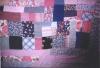
Cotton quilt made from squares of patterned and plain materials. It has a mauve cotton flounce around the border and a mauve cotton backing. There is no padding.
2700 x 1350mm
2700 x 1350mm
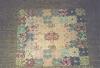
Cotton quilt of pieced hexagons and some diamonds made for a baby's basket. Colours are mainly blue and pink and two 'Punch and Judy's' are appliqued in the centre. There is no padding and the backing is a cotton floral in blues and greens.
760 x 660mm
760 x 660mm
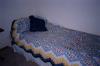
Single bed quilt made up entirely of hexagons in 'Granny's Flower Garden' pattern. The rosettes are made up of 8 hexagons and a central one. Native flower prints, including wattle, on a white background. Plain hexagons in white, yellow and blue form a scalloped border. Hexagons are hand stitched and the 2 layers are quilted in running stitch. The backing is a pieced sheet.
2400 x 1500mm
2400 x 1500mm
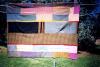
The quilt consists of 2 layers of random pieces of woollen coating and suiting materials machined together, very dark colours on one side and a mixture of dark and lighter on the other. The 2 layers are quilted together with a row of machining and has a folded and machine stitched edge. There is no padding.
1270 x 950mm
1270 x 950mm