Quilt No.624PWH - The Pioneer Women's Hut

Owner: 
The Pioneer Women's Hut
Location: 
NSW Riverina
Maker
Maker: 
Catherine Anderson
Made in
AUSTRALIA NSW
Date: 
1901 - 1920
Description: 
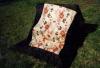
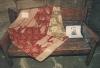
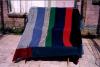
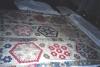
Quilt top of patches of tailors' samples and men's suiting pieces in dark colours, mainly black and grey. Machine construction. It has a border of rose coloured velveteen and the backing is a single piece of cream patterned flannelette.
History: 

The quilt was made by Catherine Anderson of 'Selby Grange' Brockelsby NSW between 1912 and 1827. It was used in Catherine and Robert's home until 1945 when it passed to their son Jack and his wife Evelyn and later their daughter Joan (Hooper) who donated it to The Pioneer Women's Hut. It is displayed occasionally at the museum.

Story: 

Catherine Anderson (born Knese) lived with her husband Robert, and their son, John Henry (Jack) in a wattle and daub house on 'Selby Grange' at Brocklesby, NSW from 1912 to 1927. The quilt was made for general use. When Catherine and Robert retired to Albury they also used the quilt in their new home. Following their deaths in 1945 the quilt was used in Jack's house, with his wife Evelyn and daughter Joan. When Joan married (Hooper) in 1949 she took the quilt and used it mainly while caravanning with young children in the 1950s, 60s and 70s.
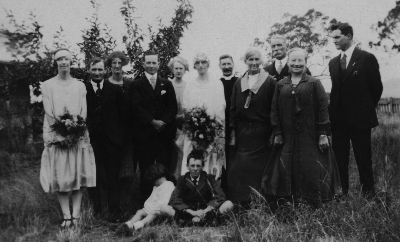
Family wedding group. Catherine Anderson on the right. 1926
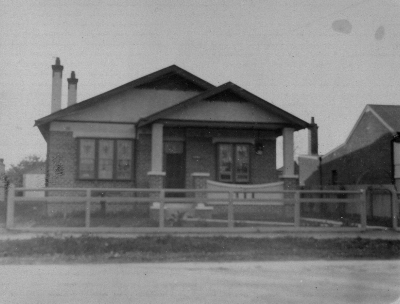
The house Catherine and Robert retired to in Albury

Related Quilts:

National Gallery of Australia
" Reversible patchwork quilt of woollen suiting in grey, blue, navy, maroon and brown. The fabrics appear to be new tailor's sample pieces (the sizing is still present on the fabric, signifying it has never been washed). The patches are rectangular and vary in size. Both sides have different designs. The front of the quilt has 4 rows of 12 vertical rectangles then below this are 4 rows of 7 horizontal rectangles followed below by 4 rows of 11 vertical rectangles. The reverse of the quilt has a section at the top and bottom composed of 5 rows of 9 horizontal rectangles. The central area is made up of a centre section of 6 rows of 5 vertical rectangles; flanked on either side by a column of 10 horizontal rectangles and two columns of 8 smaller vertical rectangles.
The patchwork layers are joined at the edges with machine stitching. The patchwork layers and padding are machine quilted on the front down 2 vertical lines following joins in the patchwork; therefore not being totally straight. The lines are more noticeable on the reverse as the 2 sides do not match. The front face is displayed at the NGA.
Between the patchwork layers is a striped cotton blanket in black, sky blue, white and cream." [NGA]
2082 x 1386mm
National Gallery of Australia
"The Rajah "quilt" is a patchwork and appliquéd bed cover or coverlet. It is in pieced medallion or framed style: a popular design style for quilts in the British Isles in the mid 1800's. There is a central field of white cotton decorated with appliquéd (in broderie perse) chintz birds and floral motifs. This central field is framed by 12 bands or strips of patchwork printed cotton. The quilt is finished at the outer edge by white cotton decorated with appliquéd daisies on three sides and inscription in cross stitch surrounded by floral chintz attached with broderie perse on the fourth side. All fabrics used in the Rajah quilt are cotton with the exception of small amounts of linen and silk threads. The quilt shows evidence of being produced by many hands." [NGA] The quilt is not padded or lined. 3372 x 3250mm
Heather Roobol
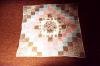
Patchwork quilt has three centre squares, one in blue/white/brown in a cross pattern, one in framed square, one with diagonal strips in a pink frame. The rest of the quilt is made from strips of rectangles in different sizes sewn in rows. There is a narrow pieced frame, then an outer border of pieced rectangles. Mostly pastel colours. No padding. Backing is calico. There is a little embroidery.
2160 x 1601mm
Catherine Ringwood
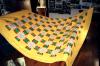
The top of this quilt is 6 x 5 alternating squares and rectangles of check woollen material in 12 or more colour ways. Herringbone stitch in yellow stranded cotton is worked along each join and border.The border is plain grey wool. There is no padding and the backing is light blue crepe.
1118 x 814mm
Powerhouse Museum
"A tied patchwork wagga quilt made from swatches of men's wool suiting fabrics in blue/grey and pink/brown tonings. Rectangular swatches have been cut in half diagonally, and the resulting right-angled triangles paired to form larger equilateral triangles which alternate dark with light across the field. The quilt has been machine and hand pieced, then machined in vertical stripes.
The centre field is bounded by two strip-pieced borders at top and bottom, and three down each side. These are sewn from rectangles, using light pink/brown tones for the inner border and darker colours for the outer borders. The quilt is padded and backed and the side seams are secured with black herringbone stitch. The three layers are tied together invisibly with lazy daisy stitches in black cotton from the back." [PHM] The padding is a wool blanket and the backing is two pieces of cream twill cotton.
2030 x 1440mm
Irene Pascoe
Utilitarian cot quilt. The padding is layered reused woollen materials, parts of old blankets, part overcoats. These are stitched together with string and knitting wools The top and backing are printed cotton. There is a frill all around and buttons have been used to anchor the padding layers to the outside cover.
1169 x 915mm