Quilt No.1029JL - Joyce Lannin

Joyce Lannin
Owner: 
Joyce Lannin
Location: 
WA Country
Maker
Maker: 
Joyce Lannin
Made in
AUSTRALIA WA
Date: 
1941 - 1970
Description: 
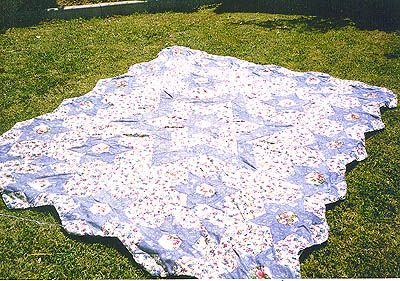
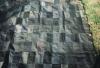
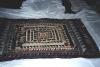
The centre of the quilt is a small blue 6 pointed star surrounded by a larger blue star. Blue stars also form a border to the quilt. The background material is a multicoloured small floral pattern on white cotton. The quilt is all hand worked over templates. The padding is cotton and the backing is polyester sheeting with a border of stars.
2650 x 2475 mm
History: 

The quilt was made by Joyce Lannin at Lake Grace, Western Australia in the 1960s. It was made for her grand-daughter Danielle Ruth England. Danielle owns the quilt and it is still used.

Story: 

Joyce Lydia Lannin. "As long as she can remember Joyce has had an interest in sewing. As a small child she sat and watched her mother sewing at the machine or doing fancy work by hand so it is not surprising that she soon had a needle and cotton in her hands
When her mother began doing patchwork it was no wonder that Joyce took an interest in that too. From her mother she obtained her first hexagon template and was soon spending all her spare time sewing medallions together to make her first quilt. She worked the medallions in patterns as the ideas came into her head with the result that the quilt is very beautiful. At this time there were no books as it was before patchwork became popular.
After completing the first quilt Joyce decided to make a quilt for each of her four granddaughters. These quilts were made with large patches forming stars in the colours of their bedrooms. They are all different as the patches are arranged differently and thus each has its own appearance."
�������.."Joyce has only made her quilts from patches she has in her scrap box. They have all been made by hand and sewn by hand. The backs are all made from sheets with a row of patchwork flowers at the edge." [Joyce Lydia Lannin]

Related Quilts:
National Gallery of Australia
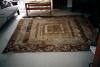
" Reversible patchwork quilt of woollen suiting/upholstery fabrics in khaki, greys, blues and browns. Both sides have different designs. The front of the quilt has 13 rows of 12 vertical rectangles flanked on either side by a column of 22 horizontal rectangles. The reverse has a more interesting and complex design of small and very large rectangles, squares and triangles; with khaki contrasting with the duller greys and blues. The patchwork layers are joined at the edges with machine stitching and the quilt is machine quilted along 3 horizontal lines following joins in the patchwork; therefore not being totally straight. These lines are more noticeable on the reverse. The reverse face has been on display at the NGA." [NGA] There is a cotton blanket used as padding. 2054 x 1451mm
Gillian Sullivan
Quilt made of 9120 very small Suffolk Puffs, each one about the size of a 20 cent piece. "Each piece backed and the front of it drawn up like a reticule. It was not backed and was rather fragile, so I backed it on to a sheet, as it was heavy and in danger of tearing when lifted." [Gillian Sullivan]
2360 x 2230 mm
Phyllis Dowling
Hand pieced cot quilt made from small rectangular shapes of a great variety of materials including cottons, silks, wools and velvets. The backing is cotton sateen in 3 colours and is brought to the front to form a border of pink, cream and yellow.
1170 x 920mm
Kristine Gray
Double sided frame quilt. All reused materials including corduroys, wools and light weight suitings. Machine made and not quilted There is no padding as already heavy and warm.
1780 x 1530mm
Powerhouse Museum
Reversible cot quilt, hand pieced, in the log cabin pattern; the blocks measure 150mm square. The patches have been cut from plain and patterned dress, pyjama and men's shirt fabrics. Strong diagonals were created in the overall design through using light and dark colours, often a strong red, to divide the log cabin blocks in half diagonally. The back is made from rectangles of striped men's shirt fabrics in pastel blues, pinks and browns with a large 'flowe' in each corner, each pieced from six hexagon patches around a central seventh hexagon. There is no padding.
[PHM] 1720 x 1150mm
National Gallery of Australia
" A wide range of cotton fabrics have been used to make this quilt in the traditional log cabin style. The strips of the log cabin are joined by rows being hand sewn onto a small square backing fabric, each square of strips has then been hand sewn together to form the quilt. The work is backed with a sateen printed fabric decorated with paisley design. A strip of the lining trims the edge of the front face of the quilt. The lining is attached with machine stitching. There are numerous tacking stitches that remain in the front face of the quilt. There are approx 9000 pieces in the quilt, most being only 5mm in width.
The quilt is of three layers because the strips of the log cabin are attached to a backing piece, and then the quilt is lined; however it is not padded." [NGA]