
Quilt No.751PHM - Powerhouse Museum
Owner:
Powerhouse Museum
Location:
NSW Sydney
Maker
Maker:
Mrs Lawrence
Made in
AUSTRALIA NSW
Patterms
Date:
1901 - 1920
Description:
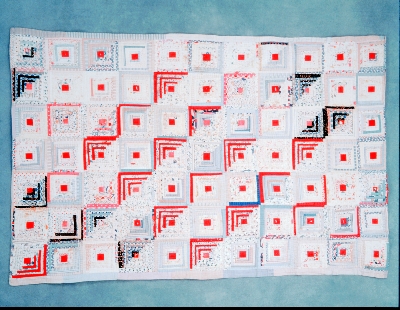
Reversible cot quilt, hand pieced, in the log cabin pattern; the blocks measure 150mm square. The patches have been cut from plain and patterned dress, pyjama and men's shirt fabrics. Strong diagonals were created in the overall design through using light and dark colours, often a strong red, to divide the log cabin blocks in half diagonally. The back is made from rectangles of striped men's shirt fabrics in pastel blues, pinks and browns with a large 'flowe' in each corner, each pieced from six hexagon patches around a central seventh hexagon. There is no padding.
[PHM] 1720 x 1150mm
[PHM] 1720 x 1150mm
History:
The maker was Mrs. Lawrence. It was made in NSW about 1910. Bert Lawrence, Mrs Lawrence's son gave the quilt to the Powerhouse Museum, Sydney in 1973. The quilt is used for research and exhibition purposes only.
Story:
"The quilt was brought to the museum in about 1973 by Mrs. Bert Lawrence, as her husband was not well. According to her, Bert remembered being sent to the tailor's shop as a child of five or six to buy samples of cotton fabric for his mother's patchwork. His father did contract work, fencing etc, around NSW and Queensland."
[Powerhouse Museum]
Related Quilts:
Hand sewn quilt (possibly child's or table top) of crazy patchwork in silk, silk ribbon and cotton velvet. The top has surface decoration of embroidery on all seams, feather stitch and blanket stitch variations. Many of the crazy patches are also embroidered. The centre patch has a rooster embroidered in lame thread. Embroidered motifs are hearts, butterflies, guitar, cow, Little Red Riding Hood, horseshoes, crown, clover leaf. Stitches are feather, stem, satin and blanket. Embroidered initials are 'B', 'R', and 'S'. The backing is dark grey silk.
840 x 840mm
840 x 840mm
Randomly patched quilt in many different colours and fabrics. There are appliquéd shapes over many pieces including Suffolk Puffs, hearts, hexagons and other shapes. There is an embroidered inscription "A11 to S11 1829" which is thought to mean AN to SN 1829. There is no padding and the backing is white cotton.
2000 x 2200mm
2000 x 2200mm
Machine sewn reversible quilt. Side 1 is rectangles of men's suiting samples in mainly grey, navy and black, stripes and self patterns. Side 2 is men's suiting samples but also includes woollen rectangular pieces in plain blue and deep pink. There is a hand sewn binding of fine orange-brown wool. The padding is hessian and cotton.
1460 x 1100mm
1460 x 1100mm
Quilt top of hexagons in silks and satins, pieced over papers in the English tradition. Some paper templates still in place. One states: 'Semi - Monthly Regular Clipper packets to New Zealand, Port Phillip, Sydney�2nd of each month..Adelaide' suggesting it may have been from a shipping timetable.
1580 x 1830mm
1580 x 1830mm
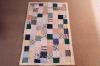
The quilt's construction is cotton patches about 170mm square joined in strips and then the strips joined. The border and backing are pale lemon coloured cotton lawn. The padding is an old woollen blanket. There is ric-rac braid around the border of the top.
2180 x 1420mm
2180 x 1420mm
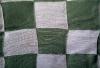
Quilt of alternate green and fawn squares (100mm) in knitted fabric, originally swatches of sample fabrics. Padding is a piece of old blanket. Backing is fawn flannelette, and the quilt is finished with a flannelette ruffle.
1423 x 1124mm
1423 x 1124mm