Quilt No.932NC - Mrs Noleen Caarthew

Mrs Noleen Caarthew
Owner: 
Mrs Noleen Caarthew
Location: 
SA Adelaide
Maker
Maker: 
Emma Loder
Made in
AUSTRALIA SA
Date: 
1921 - 1940
Description: 
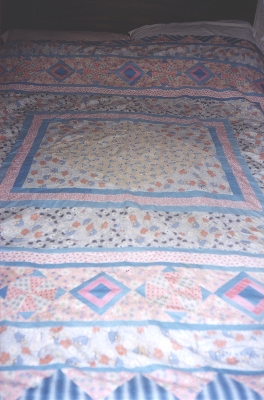
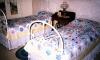
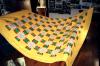
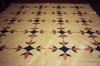
Hand stitched quilt top in printed cotton with central frame of elongated diamond of orange/blue squares and triangles. Borders are mainly squares set on point, triangles, strips, pinwheels and log cabin.
2140 x 1850mm
History: 

The quilt top was made by Emma Jane Loder (born Lloyd) 1842 - 1938 between 1920 and 1930. Emma made many quilts in her lifetime. It has been passed down in the family and is now owned by Mrs. Noleen Carthew (born Beasley) great grand-daughter of the maker.

Story: 

Emma was born in 1842 in SA and went to the Coolgardie gold fields with her daughter Mrs. N.C.Bottrill (born Loader) and their children (and a cocky and a galah) to join their husbands. They saw the New Year of 1896 in outside Bulla Bullin where the coach had broken down. They eventually arrived at Coolgardie and the women had to finish constructing the house they were to live in.
"My husband was working in the mine, but all the house he had for us to live in was some large sheets of iron leaning against a large log and the first thing I had to do was to cut some poasts and dig holes and put them in the ground, then cut corn sacks open and sew them together and nail them to the poast then put the iron on it for a roof and sewed more bags up and lined it inside too, then got some big cases from the store ' there was always plenty of cases to be got which the goods came up in' and made doors and window frames and put some micha 'from the micha mine which was about 3 or 4 miles away' and put micha in for glass, then I papered the inside with newspapers and whitewashed the outside, it was quite a smart house. I pugged the floors to make them hard and sewed bags together for carpets, then I started making the furniture, I made bedsteads, tables, sofas, chairs and cupboard all out of boxes and had a comfortable home. I got the storekeeper to get me a Metters stove then I found I had to put in some poast, a few feet from the house and nail nails on them to keep the horses and camels from breaking the house. I also made a garden and in the winter I had plenty nice vegetables, but the water was too dear and scarce in the summertime, it was then 1/- for a kerosene bucket full of condensed water, and only allowed to have one bucket a day, and if the thunder storm came up, we put everything that would hold water, around the house to catch the droppings from the roof, even the jam tins.
During my stay in Western Australia I made quite a number of different homes like that but as the trains got going on the fields and we could get iron cheaper, we made the walls of iron and boxes made into board floors and I built a brick chimney for my stove and lined the inside of the iron walls with oilcloth and had linoes on the floors (quite smart then)."
[Extract reminiscences of Emma Jane Loader 1938 courtesy Noleen Carthew and David Beasley Adelaide]
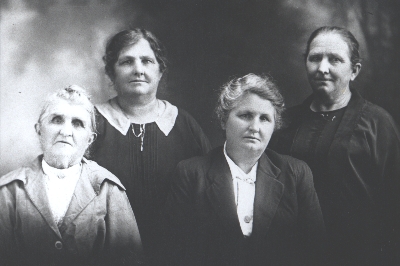
Emma Loader with her 3 daughters, Harriett, Violet, Matilda (Rt)

Related Quilts:

National Gallery of Australia
" Reversible patchwork quilt of woollen suiting/upholstery fabrics in khaki, greys, blues and browns. Both sides have different designs. The front of the quilt has 13 rows of 12 vertical rectangles flanked on either side by a column of 22 horizontal rectangles. The reverse has a more interesting and complex design of small and very large rectangles, squares and triangles; with khaki contrasting with the duller greys and blues. The patchwork layers are joined at the edges with machine stitching and the quilt is machine quilted along 3 horizontal lines following joins in the patchwork; therefore not being totally straight. These lines are more noticeable on the reverse. The reverse face has been on display at the NGA." [NGA] There is a cotton blanket used as padding. 2054 x 1451mm
Gillian Sullivan
Quilt made of 9120 very small Suffolk Puffs, each one about the size of a 20 cent piece. "Each piece backed and the front of it drawn up like a reticule. It was not backed and was rather fragile, so I backed it on to a sheet, as it was heavy and in danger of tearing when lifted." [Gillian Sullivan]
2360 x 2230 mm
N.S.W. Parks and Wildlife Service
Large centre rectangle of hexagons in various colours of patterned and plain cottons. It is surrounded by a wide border in a checkerboard of red and white cottons. There is a wholecloth cotton backing. The front and the back have been turned under at the edge and machined. There is no padding.
1829 x 1372mm
Phyllis Dowling
Hand pieced cot quilt made from small rectangular shapes of a great variety of materials including cottons, silks, wools and velvets. The backing is cotton sateen in 3 colours and is brought to the front to form a border of pink, cream and yellow.
1170 x 920mm
The Embroiderers' Guild of S.A.Inc Museum
4 Pieces of a patchwork quilt which was formerly a whole quilt. It is pieced in cottons in blues reds and browns in many prints. There are whole circles and pieced circles against a plain cream calico background. It is wool lined and is quilted. There are the initials 'A.B.' and '1828' on a central piece. The 4 pieces are various sizes.
National Gallery of Australia
" A wide range of cotton fabrics have been used to make this quilt in the traditional log cabin style. The strips of the log cabin are joined by rows being hand sewn onto a small square backing fabric, each square of strips has then been hand sewn together to form the quilt. The work is backed with a sateen printed fabric decorated with paisley design. A strip of the lining trims the edge of the front face of the quilt. The lining is attached with machine stitching. There are numerous tacking stitches that remain in the front face of the quilt. There are approx 9000 pieces in the quilt, most being only 5mm in width.
The quilt is of three layers because the strips of the log cabin are attached to a backing piece, and then the quilt is lined; however it is not padded." [NGA]