Quilt No.225NTA - National Trust of Australia (SA)
National Trust of Australia (SA)
Owner: 
National Trust of Australia (SA)
Location: 
SA Country
Maker
Maker: 
Emily Augusta Kingdon
Made in
SHIPBOARD England
Date: 
1851 - 1880
Description: 
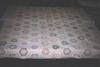
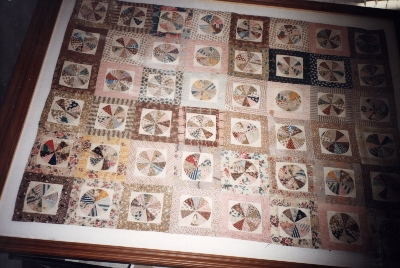
Double bed patchwork coverlet of pieced blocks in a pinwheel or dresden plate pattern of prints on a cream ground, each block with a 1 3/4" border or sash. Each pinwheel has 10 pieces, and the quilt is constructed 8 blocks by 6. Cotton fabrics are in florals, checks and stripes, in blues, greens browns, pinks, purple. The quilt was in poor repair and has been reduced in size. Conservation work has been done by the State Conservation Centre.
Backing or filling unknown.
History: 

Believed to have been made by Emily Augusta Kingdon on the voyage to South Australia after her marriage in England to Young Bingham Hutchinson in 1852. Used by the Hutchinson Family. Acquired by the National Trust of Australia (South Australia), the Goolwa Museum, c.1970.

Story: 

"Mr Young Bingham Hutchinson came to South Australia in 1836 aboard the ship Buffalo. Mr Hutchinson was involved in exploration in the area south of Adelaide in 1837 in company with Strangways and others.
In 1852 he returned to England and married Augusta Emily Kingdon and returned to South Australia.
It is believed that on this journey Mrs Hutchinson made the quilt that some years ago was given by her family into the care of the Goolwa Museum.
While the quilt has been in the museum for many years it has not been displayed in ideal conditions.
Recently the Quilters Guild donated a quilt to the museum to be raffled to raise funds for the conservation and display of the Hutchinson quilt. The proceeds of this raffle along with further fund raising as well as a State Government grant of $450 presented by Premier Dean Brown last Friday to Museum Chairman Frank Tuckwell has amounted to $1200, the complete quilt conservation cost.
The quilt conservation/display project was undertaken by Yilki Picture Framers in consultation with Artlabs Australia in Adelaide and the result shows this work of art in all its beauty. �"
[From Southern Argus 15/2/96]

Related Quilts:
National Trust of Australia (SA)
Patchwork frame quilt made from cotton prints. Quilt centre has four pieced squares set within a star shaped border of square patches, set within a square frame (74cm square) edged with half triangles, then set within a red frame (114cm x 114 cm), diamond shaped or 'on point'. In the 4 triangles are double diamond shapes, then a wide border of squares and 'square within a square' patches with red triangles. Red binding. Padding is probably wool. Backing is a cotton print in browns in a floral paisley. All over quilting. Handsewn.
1880 x 1850mm
Diana Cameron
Small patchwork piece possibly made from salesman's samples. There is no opening in the back so it is not a cushion cover. There is no padding. The backing is green polished cotton. There is a 40mm fringe around the edge.
520 x 520mm
Nancy Dunlap
Quilt top in block design based on hexagons in a variety of patterned cotton with a plain pink hexagon in the centre. The hexagons are linked by triangles of pink cotton. Cottons include florals, stripes, checks, tartans and novelty prints. 2080 x 2300mm
June Dean
Pieced hexagons, English paper method. Large hexagons form the centre with a border of smaller hexagons. The fabrics are all cotton in a wide range of colours and patterns. There is no padding. The backing is cotton, large white floral design on dark blue. The hexagons are hand pieced and the edges machined.
2480 x 1420 mm
Gillian Sullivan
Quilt made of 9120 very small Suffolk Puffs, each one about the size of a 20 cent piece. "Each piece backed and the front of it drawn up like a reticule. It was not backed and was rather fragile, so I backed it on to a sheet, as it was heavy and in danger of tearing when lifted." [Gillian Sullivan]
2360 x 2230 mm
Kay Jones
Quilt top with English piecing in a star in polygon pattern. English and French cotton fabrics in a wide variety of patterns and plains constructed over papers with the tacking still in tact. Papers are mainly part envelopes some with stamps and post dated 1898. 2200 x 1800mm