Quilt No.908UB - Una Braby

Una Braby
Owner: 
Una Braby
Location: 
QLD Brisbane
Maker
Maker: 
Amelia Brown
Made in
AUSTRALIA NSW
Date: 
1851 - 1880
Description: 
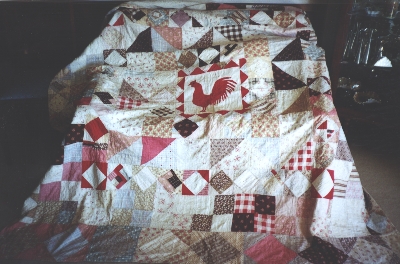
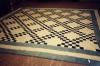
Frame quilt pieced from square, rectangular and triangular pieces from plain and patterned cotton. The central motif of the rooster is appliqued in red cotton on white background with a border of red triangles. There is a white cotton backing.
2000 x 1925mm
History: 

The quilt was made by Amelia Brown (1817-1905) at Bowning NSW probably between 1856 and 1880. The quilt has only been in the Brown family linen cupboard, first at Bowning where Amelia lived with her youngest son John Brown until he died and then Binalong where she lived with William Brown, father of the present owner Una Braby, at 'Emu Flat'. Una has owned the quilt for the last 20 years. It is not used now.

Story: 

Amelia Brown was born in Devon, England, the daughter of James and Mary Parsons. She married John Brown in 1836 and they came to Sydney in 1857, at the height of the goldrushes, with their 7 children. They settled on a property called 'Oakvale' at Binalong near Yass NSW. "The original old home was burnt during a bush fire about 1938. 1 1/2 miles further down Banjo Paterson's father lived, he is buried in Binalong cemetery."
"I never met my grand-mother Amelia Brown of Bowning as I am the only surviving member of a family of 7 children, and I am now approaching the age of eighty years." [Una Braby 15.2.2000]

Related Quilts:
National Gallery of Australia
" Reversible patchwork quilt of woollen suiting/upholstery fabrics in khaki, greys, blues and browns. Both sides have different designs. The front of the quilt has 13 rows of 12 vertical rectangles flanked on either side by a column of 22 horizontal rectangles. The reverse has a more interesting and complex design of small and very large rectangles, squares and triangles; with khaki contrasting with the duller greys and blues. The patchwork layers are joined at the edges with machine stitching and the quilt is machine quilted along 3 horizontal lines following joins in the patchwork; therefore not being totally straight. These lines are more noticeable on the reverse. The reverse face has been on display at the NGA." [NGA] There is a cotton blanket used as padding. 2054 x 1451mm
Gillian Sullivan
Quilt made of 9120 very small Suffolk Puffs, each one about the size of a 20 cent piece. "Each piece backed and the front of it drawn up like a reticule. It was not backed and was rather fragile, so I backed it on to a sheet, as it was heavy and in danger of tearing when lifted." [Gillian Sullivan]
2360 x 2230 mm
N.S.W. Parks and Wildlife Service
Large centre rectangle of hexagons in various colours of patterned and plain cottons. It is surrounded by a wide border in a checkerboard of red and white cottons. There is a wholecloth cotton backing. The front and the back have been turned under at the edge and machined. There is no padding.
1829 x 1372mm
Phyllis Dowling
Hand pieced cot quilt made from small rectangular shapes of a great variety of materials including cottons, silks, wools and velvets. The backing is cotton sateen in 3 colours and is brought to the front to form a border of pink, cream and yellow.
1170 x 920mm
The Embroiderers' Guild of S.A.Inc Museum
4 Pieces of a patchwork quilt which was formerly a whole quilt. It is pieced in cottons in blues reds and browns in many prints. There are whole circles and pieced circles against a plain cream calico background. It is wool lined and is quilted. There are the initials 'A.B.' and '1828' on a central piece. The 4 pieces are various sizes.
National Gallery of Australia
" A wide range of cotton fabrics have been used to make this quilt in the traditional log cabin style. The strips of the log cabin are joined by rows being hand sewn onto a small square backing fabric, each square of strips has then been hand sewn together to form the quilt. The work is backed with a sateen printed fabric decorated with paisley design. A strip of the lining trims the edge of the front face of the quilt. The lining is attached with machine stitching. There are numerous tacking stitches that remain in the front face of the quilt. There are approx 9000 pieces in the quilt, most being only 5mm in width.
The quilt is of three layers because the strips of the log cabin are attached to a backing piece, and then the quilt is lined; however it is not padded." [NGA]