Quilt No.360MS - Margery Smith

Margery Smith
Owner: 
Margery Smith
Location: 
NSW Riverina
Maker
Maker: 
Margery Smith
Made in
AUSTRALIA NSW
Date: 
1941 - 1970
Description: 
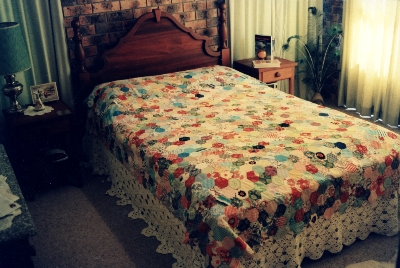
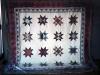
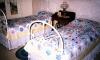
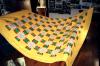
Patchwork quilt made from hexagons 63mm across in a variety of cotton prints and plains. The bright coloured patches came from children's clothes and dressmaking scraps. The 'set included a large cot cover, a pillow cover and a circular stool cover. No padding. Backing of unbleached calico. Hand sewn.
2300 x 1840mm
History: 

Made in the late 1960s - early 1970s by Margery Smith of Tumut (NSW), and owned by her.

Story: 

"The quilt was completed on 23/7/1973 when the date was stitched on. The project took about three years using what time I had available.
At that time I had a terminally ill daughter. Each afternoon when the weather was suitable I laid her on a bean bag with her legs in the sun to strengthen them. Whilst I sat talking to her I made the patchwork quilts.
I had bags of scraps from many years of sewing for my daughters and myself. This was a way to utilize them.
First I cut a stiff cardboard template then using it as a pattern I cut hundreds of stiff paper hexagons (I had all my family saving stiff paper, glossy magazines were great.) Next all the material scraps were sorted and pressed. The template was again used to cut each piece to shape leaving a turning all round.
Each piece of material was carefully turned in and tacked to a prepared paper pattern. As all pieces of a material were used they were put into boxes. I had decided to keep to a theme in order to distribute the various materials through the quilts. This stage seemed to take forever. I had worked out approximately how many 'patches' I would need.
So to the more interesting part, and it really did take forever! A centre was chosen usually checked gingham as I had a lot of those, six patterned pieces were hand stitched around each centre. I soon got back to using a thimble as the finger developed a 'hole'.
When these were done all had to be joined and the missing patch inserted, again usually the checked gingham. Removing all the tacking and papers was no small chore but the quilts were taking shape.
After that came the unbleached calico linings, stitch, stitch, stitch, then presto all was done.
I had made a separate 'sham' to cover the pillow for the bedspread, a large cot cover and also a top for a bedroom stool.
Nowadays my daughters look at the quilts and pick out their school uniforms, dresses they wore to birthday parties, socials and other nostalgic occasions. Their sister's frocks too, especially a blue one that matched her eyes. When she had her black curls tied back with a matching ribbon my middle daughter used to say, 'Oh you do look nice when you are all clean and paid for'. That saying came from my Grandmother. Really a patchwork quilt is one way of recording family history."
[Notes from Margery Smith, 1998.]
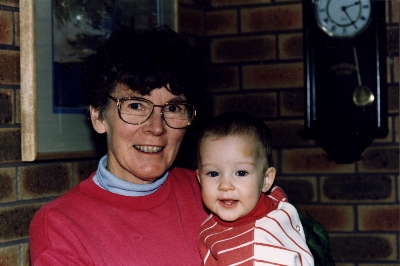
Margery Smith with grandchild

Related Quilts:

National Pioneer Women's Hall of Fame
Patchwork top made in the Log Cabin pattern in cotton fabrics, 10 x 10 squares. Hand sewn. Most fabrics are patterned, colours in darks and lights include blues, red and pink, greys, browns. The wide border is made from 3 rows of blunt ended triangles (tumbler), the edge is bound with a narrow strip of patterned grey and white fabric. Each corner of the border has 3 chequered squares set on the diagonal. Hand sewn, the binding is machine sewn. No padding or backing.
2360 x 2340mm
Mare Carter
Quilt of alternate green and fawn squares (100mm) in knitted fabric, originally swatches of sample fabrics. Padding is a piece of old blanket. Backing is fawn flannelette, and the quilt is finished with a flannelette ruffle.
1423 x 1124mm
National Gallery of Australia
" Reversible patchwork quilt of woollen suiting in grey, blue, navy, maroon and brown. The fabrics appear to be new tailor's sample pieces (the sizing is still present on the fabric, signifying it has never been washed). The patches are rectangular and vary in size. Both sides have different designs. The front of the quilt has 4 rows of 12 vertical rectangles then below this are 4 rows of 7 horizontal rectangles followed below by 4 rows of 11 vertical rectangles. The reverse of the quilt has a section at the top and bottom composed of 5 rows of 9 horizontal rectangles. The central area is made up of a centre section of 6 rows of 5 vertical rectangles; flanked on either side by a column of 10 horizontal rectangles and two columns of 8 smaller vertical rectangles.
The patchwork layers are joined at the edges with machine stitching. The patchwork layers and padding are machine quilted on the front down 2 vertical lines following joins in the patchwork; therefore not being totally straight. The lines are more noticeable on the reverse as the 2 sides do not match. The front face is displayed at the NGA.
Between the patchwork layers is a striped cotton blanket in black, sky blue, white and cream." [NGA]
2082 x 1386mm
Catherine Ringwood
The top of this quilt is 6 x 5 alternating squares and rectangles of check woollen material in 12 or more colour ways. Herringbone stitch in yellow stranded cotton is worked along each join and border.The border is plain grey wool. There is no padding and the backing is light blue crepe.
1118 x 814mm
Joyce Lannin
Hand sewn patchwork quilt with a pattern of blue stars. Each star consists of hexagons in the centre with part diamonds forming the star shape. The quilt is made from scraps. It is not padded and the backing is cotton and has a hexagon star border. 2660 x 2470 mm
 Dianne Gorringe
Patchwork quilt/cloth with strong overall design of very small squares. The colours are navy, red, cream, green (khaki) and fawn. There is a wide fringe on all sides. There is no padding. The backing is cotton sateen.
1240 x 126mm