
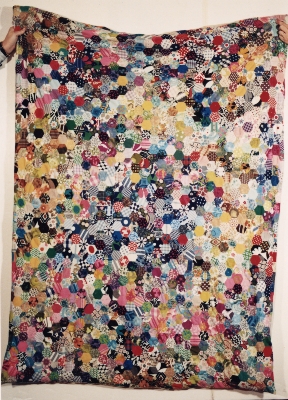
Quilt No.393CC - Cressida Mary Webb Challis
Owner:
Cressida Mary Webb Challis
Location:
NSW Sydney
Maker
Maker:
Isabel and Jean Portus
Made in
AUSTRALIA NSW
Patterms
Date:
1941 - 1970
Description:
Quilt of 50mm hexagons in random pattern. Hexagons are made from scraps of old materials with many variations of colours and patterns. One red print hexagon has "J.P." on it. The padding is an old eiderdown and the backing is calico.
1660 x 1220mm
1660 x 1220mm
History:
The quilt was made by twin sisters Isabel and Jean Portus in Sydney. It was commenced in the 1960s and completed in the 1970s. It is now owned by family member Cressida Challis and is used on the spare bed in her home.
Story:
Isabel and Jean, who made the quilt, were twin sisters. They never married. Isabel, Jean and another sister Barbara all used brass templates to make their hexagon papers. The templates were made by Barbara's husband Serge who was a fitter and turner. The papers were often cut from shareholders' annual reports and were reused a couple of times.
Isabel and Jean made many patchwork articles, made their own clothes, crocheted and knitted socks during the war.
Related Quilts:

Small square piece of crazy patchwork in silks and taffetas. Many of the seams are oversewn with decorative embroidery stitches. There is a calico backing.
550 x 550mm
550 x 550mm
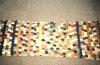
Continuous 'sleeve' of hand sewn small hexagons, many woollen, some joined, some darned, plain and patterned. Several bands of plain coloured hexagons. The padding is ticking, an old cream blanket and part of a bedspread.
1960 x 800mm
1960 x 800mm
Cotton patchwork cover constructed from hand sewn hexagons (65mm) in cotton and linen furnishing materials. The curved edges are bound with blue and cream printed striped cotton. The backing material is not visible.
941 x 261mm
941 x 261mm

American quilt in 'Dresden Plate' pattern. Hand stitched, Wide variety of cotton materials used in plain and patterned materials. The backing is cream cotton. It is hand quilted. This quilt was made from an American McCalls pattern consisting of transfers for the pieces and for the quilting design.
2400 x 1700mm
2400 x 1700mm
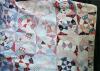
Block pattern consisting of a circle, hexagon and circle within a square. Cotton dressmaking fabrics with a few plain creams. Hand pieced and hand quilted. At some stage has been machine reinforced. Now faded, worn and damaged especially one end. Quilting pattern is four leaf clover inside large cable. The backing is 4 different pink toned fabrics in longitudinal stripes. Cotton batting. 2620 x 2300mm

Patchwork quilt made from brightly coloured printed cotton fabrics in hexagon patches hand sewn together in rosettes, and stitched by machine onto a border of bright teal blue fabric. Fabric scraps for the patchwork were donated from friends. No padding. Backing is polished cotton curtain lining.
2312 x 1969mm
2312 x 1969mm