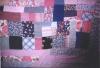
Quilt No.384LO'G - Lynette O'Grady

Lynette O'Grady
Owner: 
Lynette O'Grady
Location: 
NSW South Coast
Maker
Maker: 
Women of Reorganised Church of Jesus Christ of Latter Day Saints
Made in
USA
Date: 
1901 - 1920
Description: 
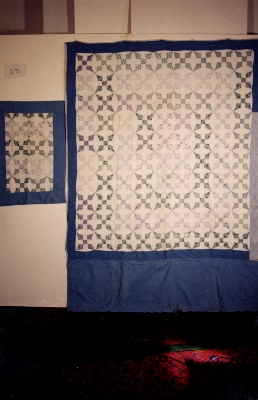
Quilt with white background and blocks in blue and green. 'Robbing Peter to Pay Paul' pattern. Plain blue border. Hand pieced and quilted. Quilt was cut down, worn center piece discarded then quilt pieces rejoined. A cover for the pillow was made from scraps when quilt was cut down.
1930 x 1740mm
History: 

The quilt was made by the ladies of the Reorganised Church of Jesus Christ of Latter Day Saints for Lily Balmour in America (probably Salt Lake City) about 1915. Lily, who was the great aunt of the present owner, gave it to her sister, the owner's grandmother, probably in the 1930s when she had returned to Australia. On her death it passed to her daughter, Lynette O'Grady's Mother (1950s) and then to Lynette in the late 1970s

Story: 

"The quilt was made for my great aunt Lily Balmour (nee White). Lily was married to an American - Alma Balmour, who was an elder / Missionary in the Reorganised Church of Jesus Christ of Latter Day Saint. She travelled with him for his work and after a period in America they were returning to Australia and the ladies of the church made her the quilt as a parting gift. My great aunt eventually gave the quilt to my grandmother (her sister). Because of her constant travelling she had to limit her luggage. The quilt was on the bed in the spare room at my grandmother's home for many years. My grandmother being a very 'practical' woman, as the quilt began to wear, cut it down the center to put the inside out. On her death my mother had it for a while and then she gave it to me. Thirteen years ago we had a house fire. It survived with some scorch marks. We are not sure of the age of the quilt. My Mother is now in a nursing home and is vague about its history."
[Lynette O'Grady 1.8.98]

Related Quilts:
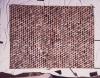
Yass & District Historical Society
Patchwork quilt made of approx. 730 Suffolk Puffs, using mainly cotton materials in florals and plains. Each puff is 45mm diameter. The quilt centre has a square of 16 pink puffs outlined with a single row of blue puffs. Each corner of the quilt has a square of 9 puffs in a single colour. No padding. Quilt is edged and backed with a red and white tartan cotton.
La Dona Anick
Red and white cross stitch quilt. Central white panel with red cross stitch embroidery featuring flowers and leaves. Red panels as borders with white embroidery, also flowers and leaves. Machine pieced. Hand quilted in an espalier pattern. There is a fine padding and the backing is homespun. 2200 x 1970mm
Christine Barnes
Cotton quilt with rosettes of hexagons. There is a centre hexagon with a surround of 6 hexagons in a contrasting pattern and then an outer row of 12 hexagons in a different pattern. Between each rosette is a single row of hexagons in a print common to the whole quilt. The materials are typical of the 60s period. There is a deep aqua border. It is machine quilted. The backing is cotton.
2515 x 1829mm
Glenda Wilkinson
The quilt consists of 2 layers of random pieces of woollen coating and suiting materials machined together, very dark colours on one side and a mixture of dark and lighter on the other. The 2 layers are quilted together with a row of machining and has a folded and machine stitched edge. There is no padding.
1270 x 950mm
N.S.W. Parks and Wildlife Service
Large centre rectangle of hexagons in various colours of patterned and plain cottons. It is surrounded by a wide border in a checkerboard of red and white cottons. There is a wholecloth cotton backing. The front and the back have been turned under at the edge and machined. There is no padding.
1829 x 1372mm
The Embroiderers' Guild of S.A.Inc Museum
4 Pieces of a patchwork quilt which was formerly a whole quilt. It is pieced in cottons in blues reds and browns in many prints. There are whole circles and pieced circles against a plain cream calico background. It is wool lined and is quilted. There are the initials 'A.B.' and '1828' on a central piece. The 4 pieces are various sizes.