
Quilt No.345TBM - Tongarra Bicentennial Museum
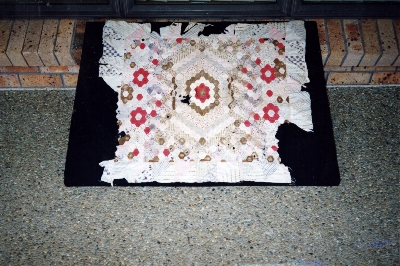
Description:
Patchwork cot quilt top made from cotton hexagon patches, featuring a centre rosette with 7 rows of patches around it forming an elongated shape, with rosettes and patches randomly placed on the sides. Quilt has a border of triangles pieced to form squares. Cotton prints with over 50 different patterns. Colours are faded, with red and brown (may be faded green) and mostly pastels. Hand sewn using whip stitch. No padding or backing.
990 x 825mm
990 x 825mm
History:
Made c.1830 in England by Sarah Thomas and used for her 10 children. The first was born in 1828, and the first three were born in England.. Owned by Sarah and then the Thomas Family. Now owned by the Tongarra Bicentennial Museum, NSW.
Related Quilts:
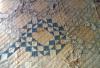
Patchwork quilt with diagonal arrangement. All cotton including cotton padding. Hand sewn and quilted.
2109 x 1702mm
2109 x 1702mm
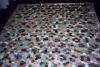
Patchwork quilt made from hexagon patches in satin and nylon, the nylon overlaid on satin. Fabrics are plain, in a mixture of dark and light colours. No padding. Backing is of pink satin with pink satin ribbon covering the joining seams. Hand sewn with some machine stitching. Feather stitching along the edge. There is no padding.
2211 x 1752mm
2211 x 1752mm
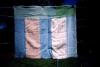
Small quilt made from pieces of heavy weight wooollen coat material cut into strips and machined together. It is reversible. Each side is made from different materials but in similar colours of aqua, blue, green and beige. The 2 layers are quilted together with a few machined lines of straight stitching. It has a folded and machine stitched edge. There is no padding.
950 x 790mm
950 x 790mm
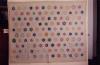
Patchwork quilt of hexagons in pattern known as 'Grandmother's flower garden'. All cotton. Rosettes are set in a white 'path' with the centre and first ring in solid colours and the second ring prints. There is a yellow border and an outer border in pink. It is hand pieced and hand quilted. The padding is cotton and the backing is white cotton with 2 border edges in light and dark blue. These borders were originally part of the top. There is an inscription "Dear daughter from Mother".
2390 x 1880mm
2390 x 1880mm
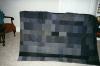
Quilt is made of wool tailors' samples, each measuring 6 x 3 1/2 inches. The colours are predominantly navy and grey. Most pieces are striped but some more distinctly than others. Both sides are mad eof smaples, one side being mainly grey and the other almost exclusively navy. There doesn't seem to be another layer of material as padding. There is no added decoration. Made on a treadle sewing machine.
1703 x 1423mm
1703 x 1423mm
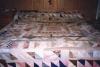
Unfinished cotton frame quilt. The centre square is 4 triangles and this is surrounded by a border of smaller triangles. Most of the other borders are of triangles in a wide variety of materials, printed and plain.
2286 x 1829mm
2286 x 1829mm