Quilt No.222RA - Rozanne Andrew

Rozanne Andrew
Owner: 
Rozanne Andrew
Location: 
SA
Maker
Maker: 
Bertha Fechner
Made in
AUSTRALIA SA
Date: 
1941 - 1970
Description: 
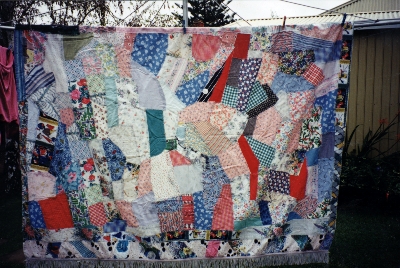
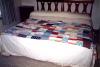
Patchwork crazy quilt of late 40s and early 50s. Pieces are from curtains, tablecloth,other kitchen type fabrics in cotton, seersucker and linen. Colours are mainly reds, greens, blues, and pastels, in prints and plain. Herringbone stitch is worked around the edge of each patch. No filling. The backing is calico with one edge in a piece of coloured cotton from the front; the calico was a little small for the top.
2020 x 1400mm
History: 

Made by the owner's grandmother, Bertha Fechner, at Loxton, SA in the early 1950s, no later than 1953. Owned by Rozanne Andrew.

Story: 

"Further on from last correspondence regarding information on 3 quilts I own from my paternal grandmother. � This is information on grandmother's life. Name - Bertha Fechner & Philip Fechner
D.O.B 19/5/1888 D. 20/12/73 D.O.B 1/6/1893 D. 5/12/46
Lived all their married [lives] at Loxton, South Australia, a town on the River Murray.
Both people of German descent but born in Australia.
Both very frugal in their use of food and possessions. Always preserved all their fruit, killed own animals, grown most of their fruit and vegetables. Grandmother of course made own clothes and many quilts in her lifetime. Many traditions from Germany passed down and carried on through the generations including language. Being able to knit, crochet, sew, embroider an essential part of education. Strong church followers always.
� Grandfather was a blacksmith and wheelright. Grandmother did 'home duties".
[Letter from Rozanne Andrew 20.12.95]

Related Quilts:
National Gallery of Australia
"This quilt follows the traditional hexagon patchwork pieced pattern, which are then joined and sometimes edged with a contrasting border. The edges of the quilt have been turned and then scalloped edges made of identical patches to the main body of the quilt have been attached to the edge. The quilt is fully lined, and the lining is visible front the front face through the gaps between the scalloped edge. The lining is attached to the patchwork with a row of stitches along the edges; there are no stitches in the centre field. The fabrics of the quilt are plain weave cotton in simple floral and geometric designs. Most of the fabrics are monochromatic. Several different colour ways of the same fabric are evident which could suggest some fabrics were from manufacturer samples. The lining is a William Morris print.
Each of the patchwork pieces (there are several thousand present) are sewn together with very fine overcasting stitches. The quilt is entirely hand sewn. There is some evidence that templates from the hexagon pieces possibly blotting paper, remain in situ���The quilt is not padded or quilted. The lining is fine twill weave cotton printed in pink and pale purple. The design follows William Morris's 'Strawberry Thief design'." [NGA] 2075 x 1911mm
Ryder Lundy
"Hexagons pieced over cardboard hand-sewn together. Each rosette was then machine quilted 1/8th to 1/4 inch from edge of rosette in shape of each rosette. Quilt is mainly cottons with a few rayons. Some checks and stripes are used but mainly florals. Has been machine quilted in rosette shape using green on green fabrics, lemon on lemon, orange on orange and red on red." [Ryder Lundy] There is no padding and the backing is gold curtain fabric extended at the end and one side with matching taffeta. 2220 x 1270 mm.
National Trust of Australia (QLD)
Crazy patchwork quilt with mainly patterned pieces in a wide variety of designs and colours. Backing is wholecloth patterned cotton. The quilt is edged with a checked bias binding. Machine construction.
2299 x 1449mm
Mrs. L. M. Chick
Hexagon quilt made by hand from a wide variety of cotton materials. There is no padding and the backing is calico.
2286 x 915mm
Lorna Calder
Patchwork quilt of multi coloured silks and brocades. Crazy patchwork borders, mainly rectangular fabrics pieced together in diagonal patterns, radiating from a central frame embroidered with flowers. Many pieces are extensively embroidered in a great variety of stitches and motifs; butterflies, sunflowers, cats, daffodils, crown, pawn broker's symbol, 'money to lend', 'good night', the initials of family members and 'mater 1890'. The quilt has a deep border of maroon sateen. There is no padding visible but it is possibly a blanket. The backing is green/gold silk with a self stripe with red cotton damask showing underneath, possibly an earlier backing.
2165 x 2165mm
National Gallery of Australia
"A medallion or framed quilt in design. There is a central field of small patchwork diamonds, and from this radiates plain stripes of fabric bordering areas of patchwork panels. The edge of the quilt carries bands of red cotton, which are slightly larger at the top and bottom edges, and here the band is additionally decorated with appliqué diamonds. The fabric of the patchwork is cotton in fine plain weave of pale coloured florals and small geometric designs. The framing and border stripes are of bright red twill weave cotton. The small diamonds of the central field are hand sewn, with more use of machine stitching around the outer edge of the quilt.
The quilt is not padded. The patchwork is fully lined with a printed plain weave cotton fabric with a design commemorating Queen Victoria's Jubilee. The design is based on a repeated grid of circles. In the centre of each circle is a cameo of Queen Victoria, surrounded by images of the national flowers of England, Scotland and Ireland: the rose, the thistle and the shamrock. The edge of the front face of the quilt is trimmed with a red and white cotton braid." [NGA] 2380 x 2220mm