
Quilt No.497LC - Lorna Cheong
Description:
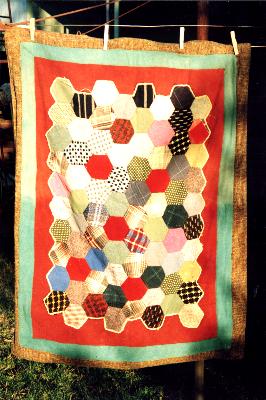
Centre of hexagon pieces edged with braid and surrounded by 3 borders of old coating materials. The hexagons and the borders are all wool. There is herringbone stitch on the edge of the rayon backing. The padding is an old cream blanket.
1000 x 750mm
1000 x 750mm
History:
The quilt was made by Mary Wood in 1950 at Markwood Victoria. It is now owned by Mrs. L. Cheong. It is still used.
Story:
Mary Wood made a number of quilts still in existence. She lived at Markwood all her married life and her husband was one of the pioneers of the district, John Moon Wood.
Related Quilts:
Double sided quilt. Side 1 has an off centre frame based on a hexagon and including triangles and squares in a concentric pattern. The borders are all small rectangles with a single strip of large rectangles at one end. Side 2 has a central patch of pieced shapes appliqued to the background. The borders are squares and rectangles many in striped shirting cotton. Side 1 has minimal quilting to the interlining but it does not go through to side 2. The padding is a thin sheet.
The circle (sometimes pieced hexagons) is common to other 'Craigmoor' quilts.
1450 x 1230mm
The circle (sometimes pieced hexagons) is common to other 'Craigmoor' quilts.
1450 x 1230mm
The top of this quilt is 6 x 5 alternating squares and rectangles of check woollen material in 12 or more colour ways. Herringbone stitch in yellow stranded cotton is worked along each join and border.The border is plain grey wool. There is no padding and the backing is light blue crepe.
1118 x 814mm
1118 x 814mm
Pieces of heavy woollen material have been strip pieced and then joined. The joined pieces have then been folded over and restitched along the sides to make a double sided quilt. It is very heavy.
1830 x 1400mm
1830 x 1400mm
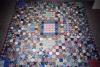
Patchwork quilt made of approx. 730 Suffolk Puffs, using mainly cotton materials in florals and plains. Each puff is 45mm diameter. The quilt centre has a square of 16 pink puffs outlined with a single row of blue puffs. Each corner of the quilt has a square of 9 puffs in a single colour. No padding. Quilt is edged and backed with a red and white tartan cotton.
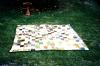
150mm squares of old material scraps, mostly cotton, including some curtain material. There is no padding and the backing is brown lawn.
2540 x 2370mm
2540 x 2370mm
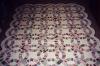
Double Wedding Ring' cotton pieced quilt. Machine constructed and hand quilted. Padding is Mountain Mist cotton. The backing is unbleached calico.
2160 x 1855mm
2160 x 1855mm