Quilt No.443DC - Dorothy Cawood

Dorothy Cawood
Owner: 
Dorothy Cawood
Location: 
VIC Melbourne
Maker
Maker: 
Francis Jane McElhinney
Made in
IRELAND
Date: 
1921 - 1940
Description: 
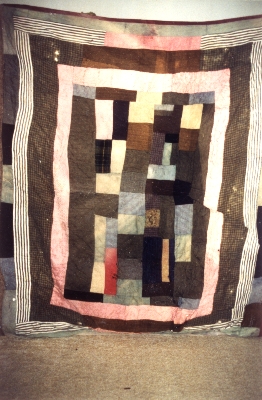
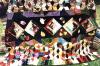
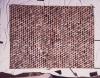
Utility quilt. Random piecing with borders. Reused materials from furnishings and clothing uncluding wool, tweed, cotton, suiting. The backing is mattress ticking and the padding is an old sheet.
1850 x 1500mm
History: 

The quilt was made by Francis Jane McElhinney 1896-1965 in Londonderry Ireland pre 1926. One of 2 quilts brought to Australia as family luggage on the Barrabool in 1926. Passed by maternal descent to the present owner, Dorothy Cawood, who is the grand-daughter of Francis. The quilts were used in Ireland and Australia for extra warmth when needed. More recently they were used under the wire mattress, as dog blankets, as moving blankets to protect furniture and as drop sheets for painting. They were stored in a back shed but are now valued and stored in the owner's house. They are not now used.

Story: 

"My grandmother Francis Jane McElhinney (nee Patterson) was born on the 15.4.1896 at Milford, Letterkenny, Eire and died on the 22.1.1965 at Melbourne. Francis and her husband Robert lived in a 2 storey house at No.1 Sydney Terrace, Great James Street, Londonderry Ire, where Martha, (my mother) and Francis were born. A third daughter, Laura was born in Australia in 1926 soon after their arrival.
My grandfather was a motor mechanic for Rover and my grandmother was a secretary/typist for a law company. I have a small Pitman's Shorthand Pocket Dictionary presented to her on passing her examinations dated July 1912. My mother also tells of her parents taking in borders to supplement their income.
The reason for leaving Ireland for Australia in 1926, was the opportunity for a better way of life.
The quilts I have were used for bedding both here and in Ireland. My Mother used them for extra warmth when needed, but I can remember them being under the mattress on my bed, whether it was for easy storage when not is use, or it kept the draught from coming up through the wire base, then they ended up in our garage.
Their belongings came to Australia in trunks, one of which I keep my embroidery supplies. As you will see from a copy of goods and chattels sold at auction* before the family sailed a lot of quilts were left behind, perhaps too bulky or heavy to transport, or maybe they thought they would not be needed in a warm country like Australia. My grandmother did not value the quilts, they were a purely functional household item, although I wonder why these 2 were kept. I also have some linen pillow shams with a crochet edge and handmade buttons, that were also used on their beds. The family moved into a house (1926 or 1927) at 71 Benjamin Street Sunshine (not far from where I live) until the 3 girls were married and their parents passed away. My grandmother taught her 3 daughters to mend, darn, crochet, knit and of course do "fancywork" which mum remembers would be done after the household chores and music practice. Mum recalls being taught to darn her socks at the age of 6 before she came to Australia."
[Dorothy Cawood 13.1.1999]
* The auction sale notice lists 3 "P.Work Quilt" and 6 "Quilt" at prices ranging from 4 shillings and threepence to one shilling. ED.
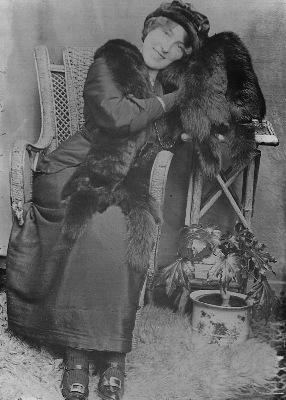
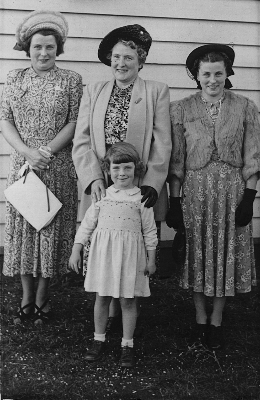
Francis Jane Patterson c.1916
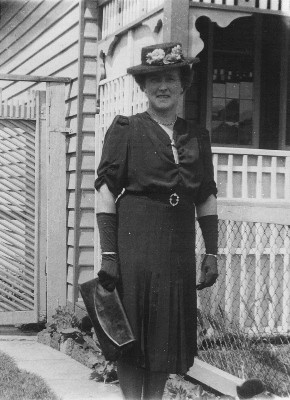
Francis Jane McElhinney 1940s
Centre:Francis McElhinney & Dorothy Jones (Cawood)

Related Quilts:

Queen Victoria Museum and Art Gallery
Quilt has a centre panel of white velvet roses and green leaves with embroidered spider webs, on red velvet. Two side panels are in crazy patchwork in plain and patterned silks and velvets. All patches are edged with feather, herringbone or blanket stitch. Many patches are embroidered, including 'Minnie', 'Good Luck', birds, flowers, anchor, boat, fish, shell, spider web, crown,, 2 crossed flags, tennis racquets, Australian motifs including wattle. The centre panel has a row of ruched olive green ribbon each side and the whole quilt has a border of dark blue velvet. The padding is cotton wadding and the backing is cream cotton printed with red and pink chrysanthemums and green leaves.
2113 x 1995mm
National Gallery of Australia
"This quilt follows the traditional hexagon patchwork pieced pattern, which are then joined and sometimes edged with a contrasting border. The edges of the quilt have been turned and then scalloped edges made of identical patches to the main body of the quilt have been attached to the edge. The quilt is fully lined, and the lining is visible front the front face through the gaps between the scalloped edge. The lining is attached to the patchwork with a row of stitches along the edges; there are no stitches in the centre field. The fabrics of the quilt are plain weave cotton in simple floral and geometric designs. Most of the fabrics are monochromatic. Several different colour ways of the same fabric are evident which could suggest some fabrics were from manufacturer samples. The lining is a William Morris print.
Each of the patchwork pieces (there are several thousand present) are sewn together with very fine overcasting stitches. The quilt is entirely hand sewn. There is some evidence that templates from the hexagon pieces possibly blotting paper, remain in situ���The quilt is not padded or quilted. The lining is fine twill weave cotton printed in pink and pale purple. The design follows William Morris's 'Strawberry Thief design'." [NGA] 2075 x 1911mm
National Trust of Australia (SA)
Patchwork frame quilt made from cotton prints. Quilt centre has four pieced squares set within a star shaped border of square patches, set within a square frame (74cm square) edged with half triangles, then set within a red frame (114cm x 114 cm), diamond shaped or 'on point'. In the 4 triangles are double diamond shapes, then a wide border of squares and 'square within a square' patches with red triangles. Red binding. Padding is probably wool. Backing is a cotton print in browns in a floral paisley. All over quilting. Handsewn.
1880 x 1850mm
Annette Gero
This domestic Wagga is two layers of woollen army blankets with the top layer in rectangles joined in rows. The backing is hessian bags that originally contained meat meal.
11650 x 1130mm
Nancy Dunlap
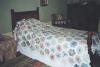
Quilt top in block design based on hexagons in a variety of patterned cotton with a plain pink hexagon in the centre. The hexagons are linked by triangles of pink cotton. Cottons include florals, stripes, checks, tartans and novelty prints. 2080 x 2300mm
The Pioneer Women's Hut
Single bed quilt made up entirely of hexagons in 'Granny's Flower Garden' pattern. The rosettes are made up of 8 hexagons and a central one. Native flower prints, including wattle, on a white background. Plain hexagons in white, yellow and blue form a scalloped border. Hexagons are hand stitched and the 2 layers are quilted in running stitch. The backing is a pieced sheet.
2400 x 1500mm