Quilt No.513NHM - Narryna Heritage Museum
Narryna Heritage Museum
Owner: 
Narryna Heritage Museum
Location: 
TAS Hobarty
Maker
Maker: 
Mary Harper
Made in
IRELAND
Date: 
pre 1850
Description: 
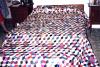
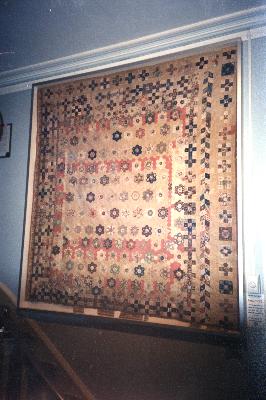
The centre rectangle consists of rosettes of hexagons. It is surrounded by borders of hexagon rosettes and squares with one long strip of diamonds. The colours are predominantly pink and fawn. It is hand stitched. In the 1980s the quilt was mended and a calico backing added.
2000 x 1800mm
History: 

The quilt was made by Mary Harper of County Dublin, Ireland c.1830 for her trousseau. In 1851 Mary and David and their 2 children came to Van Diemen's Land and settled in Fingal. The quilt remained in the family but was not specifically handed down from one generation to the next. In 1955 it was donated to the Narryna Heritage Museum by the Misses Pat and Etta Weetman great grand-daughters of Mary Harper. The quilt is displayed in a wall cabinet at the Museum

Story: 

Mary Gall (?-1878) came from Dublin and probably met her future Scottish husband, David Harper, when she was staying in Scotland in 1833. They were married in 1837 at Dunboune near Dublin and had 2 children, Alexander born in 1837 and Rosa in 1839. In 1851 the family came to Van Diemen's Land where David was steward or manager to William Talbot at Fingal. He later took over the flour mill at Millbrook, Mt. Nicholas. Rosa, the donor's maternal grand-mother married John Stanfield of 'Speyside' Fingal in 1866. Rosa and John's daughter, Rosetta Mary was born in 1867 and Mary Margaret in 1869. John Stanfield's diary of 1870 refers to domestic details such as "Rosa papering the dining room today" and "Mary walked for the first time".
Rosa's elder daughter did not marry but Mary married Percy Weetman in 1905 and their 2 daughters, Mary Patricia b.1906 and Rosetta (Etta) b.1910 were the donors of the quilt to the Narryna Heritage Centre c.1955.*
[Ref: Compilation by Anne Piesse, Hobart, 1985 from notes, letters and interviews with Etta Weetman]

Related Quilts:

Name withheld
Quilt top in postage stamp pattern typical of military quilts. 5 x 5 blocks each 280 x 280mm. Colours are predominantly red, black and cream. Thought to have been made using uniform material from the Crimean war
1350 x 1350mm
N.S.W. Parks and Wildlife Service
The top has a segmented circle in the centre surrounded by a border of small rectangles. The circle is featherstitched on to the background. Materials are wools and cottons and it is hand pieced. The other side appears to have been originally men's suiting materials strip pieced. It is now covered with a children's print in light cotton joined in long rectangles. The padding is coarse heavyweight cotton.
1410 x 1080mm
National Parks & Wildlife Service of SA
Patchwork quilt of hexagon patches (3.5cm sides approx), handsewn, in cotton fabrics in sprig prints, stripes, checks, florals and plains. Colours are pre-aniline dyes, in lavender, green, red, beige and purple. Centre of quilt is pastel colours with a central patch embroidered in red: 'Elsey Rowbotham her work May 1 1869'. Quilt has a wide border of squares and triangles.Padding is thin cotton. Backing is off white calico. Quilted in parallel lines.
2693 x 2490mm
Marjorie Treasy
Machine sewn quilt made from 125mm squares of scraps left over from dressmaking joined in strips and then the strips joined. There is a border of fawn cotton and the backing is the same material. The padding is an old blanket and the border is padded with sheep's wool.
1400 x 925mm
Helen Cornish
Patchwork quilt in the Log Cabin pattern, each square 14cm x 14cm, made of used cotton fabrics with a fine wool fabric as the centre square of each. Colours are mainly reds, blues, greens and maroon, and pastels, in prints and plains. Quilt has a wide border of dark blue cotton with mitred corners. The padding is black and white mattress ticking, and the backing is the same dark blue cotton as the border. Machine stitched.
1770 x 1170mm
Lyn Uppill
Scrap quilt made of vertical strips of rectangles alternating with narrow strips of pieced triangles. Colours are subdued, blues, pinks, red, browns and black, in small patterns and stripes. Fabrics are suiting, rayon, crepe, gaberdine, taffeta and blazer wool. The padding or middle layer is pieced from hessian and suiting fabric, knitted cotton. and khaki and brown twill (uniform material). The middle layer is then handsewn to the back.
1550 x 870mm