Quilt No.564NPW - N.S.W. Parks and Wildlife Service
N.S.W. Parks and Wildlife Service
Owner: 
N.S.W. Parks and Wildlife Service
Location: 
NSW Sydney
Maker
Maker: 
Sarah Marshall?
Made in
AUSTRALIA NSW Central West
Date: 
1921 - 1940
Description: 
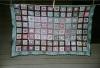
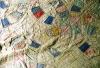
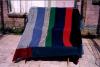
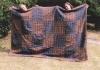
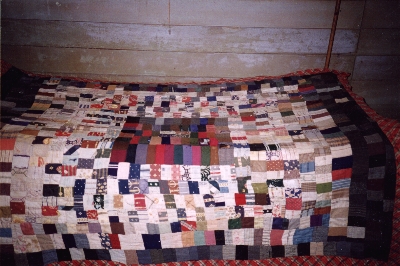
Double sided quilt with both sides based on a central frame. One side has centre panel of darks surrounding 4 patch of the same print in different colourways. This is surrounded by borders of rectanglesis small prints, checks and stripes. The outer border is men's suitings. The other side has a centre frame similar to the 'Broken Dushes' pattern surrounded by wide borders in solid colours, paisley and fine checks. There is a dark strip across the top and bottom. It is roughly machine quilted.
1770 x 1380mm
History: 

At this time it is impossible to make a definite attribution to Sarah Marshall but this quilt was almost certainly made by Sarah Marshall and/or one of her daughters, Hannah, Jean or Agnes at Hill End NSW and probably at 'Craigmoor' their family home. The exact date is unknown. It is now part of the 'Craigmoor' collection owned by the NSW National Parks and Wildlife Service and displayed at 'Craigmoor'.

Story: 

James Marshall (1828-1905) from Scotland via the Californian gold rush and Sarah Langslow Adams (1836-1926) born Herefordshire England, were married in 1858 at Hill End. Reef mining in the 1860s brought fame and fortune to this mining settlement, north of Sofala and Bathurst in NSW.
In 1875 James Marshall had 'Craigmoor' built and he and Sarah lived there with their family of 9 children, 2 having died in infancy.
The textile collection at 'Craigmoor', including the quilts, reflects the Marshall women, Sarah and her daughters Hannah (1859-1950), Jean (1867-1948) and Agnes (1871-1950) and gives a glimpse of the daily lives of the women. Needlework, including crochet, in various forms was important and some of the women made their own hats. At least in the later years it appears to have been a thrify household with many quilts made over and patched.
Hannah, a spinster, lived at 'Craigmoor' from the time it was built until her death aged 91. She taught Sunday school in Hill End and was well know locally for her bottling, preserving and jam making. She also made elderberry wine. The 3 sisters were fond of playing the piano.

[Sources: N.S.W National Parks and Wildlife Service brochure on Hill End, Sue Stephens daughter of Charles Marshall, Christine Karlsen, informal conversations with the locals at 'The Royal'. Wendy Hucker for NQR]

Related Quilts:
Arlene Crane
Cotton patchwork quilt in double wedding ring pattern in pastel prints. Quilted in a design of geometric flowers. Padding is probably cotton wadding, backing is cream calico. 2270 x 1970 mm.
Barbara McCabe
Patchwork quilt made from rectangles of mostly woollen fabrics sewn in strips and then stitched together. Fabrics left over from dressmaking projects. Machine stitched. Colours mainly green, purple, blue, pink, pastels, in plain, checks and spots. No padding or quilting. Lining is an old bedspread.
2200 x 1440mm
Alyce Wright
Cotton scrap quilt in a pattern known as 'Grandmothers Fan'. It is hand quilted. The padding is hand carded cotton and the backing is muslin.
2235 x 1880mm
The Pioneer Women's Hut
Cotton quilt in pattern commonly known as "Double Wedding Ring'. Probably an American McCall's pattern. Hand stitched, florals, checks and plain pieces. The backing is pink cotton. Scalloped edge.
2300 x 1880mm
Ruth Hansen
Quuilt constructed from large pieces of used clothing pieced together to form the top. There are layers of under shirts once used by the maker's father and also by her husband Bill. The backing is an old cream blanket.
1700 x 1200mm
Fran Williams
Quilt with centre area of silk triangles framed with small squares and the rest of the top is larger squares. Wide variety of prints and plain materials. There is no padding. The backing is cotton and "E.M.B." is cross stitched in one corner. "Back is interesting as it's all the same fabric, joined but it appears to have been stitched with a running stitch (cf quilting) before it was attached to the front. It was definitely done after being joined as the stitching design follows through the seams." [Fran Williams]
2500 x 2500mm