
Quilt No.202BL - Barbara Levy
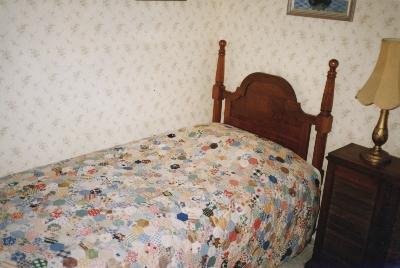
Description:
"The quilt is made up of many cotton hexagons of various colours, patterns and designs, finely sewn by hand, making a very attractive bedspread. Each patch is lined with lawn. It is quite a heavy quilt, with its plain border, and backing of home-spun cotton or cesarine. The family always called it a 'cottage design'."
No quilting.
2312 x 1905mm
No quilting.
2312 x 1905mm
History:
Made by Mrs Gordon Sides (born Iser) at 'Bundidjarie', Melvor Rd, Bendigo in 1947. Owned by her daughter Barbara Levy. It has been used in the bedroom occupied by Barbara's now married daughter Belinda.
Story:
Bundidjarie' is now demolished, replaced by a motel.
"My father Gordon Sides, an engineer, meticulously cut all the hexagons for my mother. My mother, maiden name 'ISER', was the fifth child the youngest of German parents who came to Bendigo in the early 1870s from Hamburg."
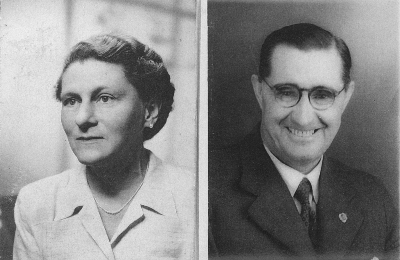
Photo of Mr & Mrs Gordon Sides 1939
Related Quilts:
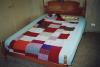
Patchwork quilt made of rectangles of woollen fabrics from dressmaking projects. Pieces have been stitched together in no particular order. Colours are predominantly dark red and light grey, with some green, pink and blue. Fabrics are plain, checks and weaves. No padding or quilring. Backing is yellow curtain fabric.
2200 x 1100mm
2200 x 1100mm
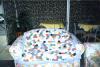
Cotton Hexagon quilt with a wide variety of patterned and plain materials. Blue binding and a cotton backing. The padding is thought to be cotton wool.
1525 x 1220mm
1525 x 1220mm
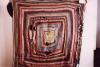
Double sided square quilt. One side is a crocheted rug. The centre of this is 4 triangles joined and from this coloured bands in crochet radiate out to the border. The other side is randomly pieced scraps of mainly woollen material in checks, plains and tartans. Machine construction.
1600 x 1600mm
1600 x 1600mm
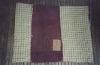
Utilitarian quilt made from large pieces of wool, flannel and cotton. Machine construction and the padding is wool.
1570 x 152Omm
1570 x 152Omm
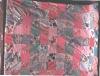
One of a pair of patchwork quilts machine sewn from squares of cottons and silks in pinks, aquas and blues in plain and print materials. Both quilts are similar. The backing is white cotton. There is no padding.
2200 x 1500mm
2200 x 1500mm
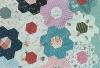
Hand sewn hexagons over paper templates in a pattern known as 'Grandmother's Flower Garden'. Materials are printed dress cottons, patterned and plain, mainly in pinks, blues and browns. The border and backing is grey linen and is machine stitched on. There is no padding. 2060 x 1579 mm.