Quilt No.1046DH - Diane Kern Hamilton

Diane Kern Hamilton
Owner: 
Diane Kern Hamilton
Location: 
WA South West
Maker
Maker: 
Elva May White
Made in
USA Montana
Date: 
1921 - 1940
Description: 
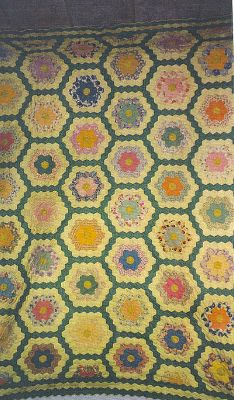
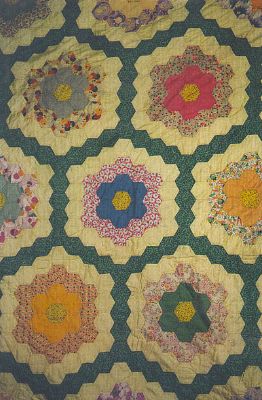
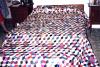
Grandmother's Flower Garden pattern constructed from hexagons with sides approx 2cms. Repeats of three concentric circles of hexagons outside a centre yellow hexagon. Each of the first two circles is made from the same fabric and the outer circle is always pale yellow. The 'pathway' is solid green. It is quilted in concentric circles 5mm in on all hexagons. There is a fine padding and the backing is yellow polished cotton. It is known as Great Aunt Elva's quilt.
2480 x 1980mm.
History: 

The quilt was made by Elva Mae White (born Decker) on their farm in Manhattan in the Bozeman area of Montana, USA probably in the 1930s. The maker left the quilt to a faithful worker, Virgil Howard, who gave it to the present owner who is Elva White's great niece. It is used occasionally for special guests.

Story: 

"Maker Elva Mae White was born approx 1880 and was married in 1901. For their honeymoon in 1902 Elva and her husband went with her husband's parents to Yellowstone National Park. They travelled in a covered wagon and a buggy and may also have taken tents. In the three weeks they were in Yellowstone NP Elva and her mother-in-law cooked and did laundry for some soldiers who hadn't seen a woman for a long time. The soldiers were working in the national park helping to build roads and establish the new national park.
On the farm Elva's husband had stud cattle and wheat. Elva would have done all the cooking and cleaning and used to get up at 5am with breakfast being at 6.30am. She was also active outside the house as she kept chickens and ducks. The house was originally a one-room log cabin built in the 1880's and was gradually added to make several rooms. Prior to her marriage Elva had taught in a one-room school.
Elva and her husband had no children so after Elva's husband died she left the house to a faithful worker on the farm, Virgil Howard, who lived in a sheep herder's cottage. Virgil left the quilt to the present owner as he knew she was interested in quilting. Elva died in 1974. Virgil told the present owner that she made other quilts but must have given them away." [Diane Kern Hamilton]

Related Quilts:
Lyn Cottingham
Single bed quilt hand pieced from silk hexagons using the English method. The border, backing and central rosette of hexagons are black. All other hexagons are a mixture of plain colours, stripes and florals. They are randomly placed. It is quilted in a diamond pattern. The padding is a thin cotton woven material.
1550 x 1330mm
Harden Murrumburrah Historical Society
Patchwork quilt has pieced blocks in the 'Ohio star' pattern in red print and white cotton, alternating with plain white blocks. Quilt has a 9cm frill in red and grey geometric print cotton, machine stitched around the edge. Quilt appears to have some hand quilting. No padding. Backing is white cotton.
2210 x 2060mm
Yass & District Historical Society
Patchwork quilt made from diamond patches in the 'Cotton Box' pattern, in a wide variety of cotton fabrics, including plains, checks, stripes and florals. The patches have blotting paper templates. The quilt is edged with diamond shapes in a red floral cotton. The backing is of the same red floral pattern, featuring yellow, turquoise and white flowers and leaves. Hand sewn.
2135 x 2033mm
Ankie King
Small square piece of crazy patchwork in silks and taffetas. Many of the seams are oversewn with decorative embroidery stitches. There is a calico backing.
550 x 550mm
Glenda Wilkinson
Small quilt made from pieces of heavy weight wooollen coat material cut into strips and machined together. It is reversible. Each side is made from different materials but in similar colours of aqua, blue, green and beige. The 2 layers are quilted together with a few machined lines of straight stitching. It has a folded and machine stitched edge. There is no padding.
950 x 790mm
Dubbo Museum & Historical Society Inc
"English patchwork pieces. 1110mm x 1500mm. Hand pieced by at least two people. Made from scraps, cut down clothing and sheeting. Backing made from shirtings, dress fabrics, furnishing fabric and ticking. No synthetics. Machine quilted. Condition, fragile�.." [Dubbo Museum]