
Quilt No.128MOV - Museum of Victoria
Owner:
Museum of Victoria
Location:
VIC Melbourne
Maker
Maker:
Unknown
Made in
PAKISTAN
Patterms
Date:
1941 - 1970
Description:
Quilt of [cotton], with geometric pattern of squares and triangles in primary colours. Tassels attached.
2320 x 1490mm
2320 x 1490mm
History:
Made in the 1950s at the village in Sind from whence Dr Kazi came. Given to the Museum of Victoria by Dr Kazi.
Story:
The Sind area, a region of Pakistan, is famous for embroidery.
"Much of the best Sind embroidery comes from the eastern area of the province around Umarkot and Chor. Embroidery in silk and cotton thread is usually worked on a ground of local cotton fabric, generally dyed indigo���..
It is the Sindi women who do the embroidery and use it to decorate clothing, quilts, covers and hangings."
[Source: 'Embroidery Traditional designs, techniques and patterns from all over the world Mary Gostelow]-
Related Quilts:
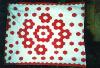
Hand sewn cotton cot quilt with pattern of red and white lozenge shaped hexagons measuring approximately 65mm from top to bottom. A centre flower is constructed from 2 circles of 19 hexagons in red and white. This is surrounded by 8 smaller hexagon flowers. Additional single red hexagons are scattered at random on the white background around the rows of flowers. The quilt is not quilted or tied but is attached at all 4 edges. Writing on the back of the quilt (probably added later) reads "Made by Sarah Hodge, Newport, Wales UK for her first child John." There is no padding and the backing is white cotton. 1000 x 1250 mm.
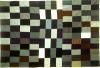
" Reversible patchwork quilt of woollen suiting in grey, blue, navy, maroon and brown. The fabrics appear to be new tailor's sample pieces (the sizing is still present on the fabric, signifying it has never been washed). The patches are rectangular and vary in size. Both sides have different designs. The front of the quilt has 4 rows of 12 vertical rectangles then below this are 4 rows of 7 horizontal rectangles followed below by 4 rows of 11 vertical rectangles. The reverse of the quilt has a section at the top and bottom composed of 5 rows of 9 horizontal rectangles. The central area is made up of a centre section of 6 rows of 5 vertical rectangles; flanked on either side by a column of 10 horizontal rectangles and two columns of 8 smaller vertical rectangles.
The patchwork layers are joined at the edges with machine stitching. The patchwork layers and padding are machine quilted on the front down 2 vertical lines following joins in the patchwork; therefore not being totally straight. The lines are more noticeable on the reverse as the 2 sides do not match. The front face is displayed at the NGA.
Between the patchwork layers is a striped cotton blanket in black, sky blue, white and cream." [NGA]
2082 x 1386mm
The patchwork layers are joined at the edges with machine stitching. The patchwork layers and padding are machine quilted on the front down 2 vertical lines following joins in the patchwork; therefore not being totally straight. The lines are more noticeable on the reverse as the 2 sides do not match. The front face is displayed at the NGA.
Between the patchwork layers is a striped cotton blanket in black, sky blue, white and cream." [NGA]
2082 x 1386mm
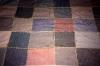
The top of this quilt is 6 x 5 alternating squares and rectangles of check woollen material in 12 or more colour ways. Herringbone stitch in yellow stranded cotton is worked along each join and border.The border is plain grey wool. There is no padding and the backing is light blue crepe.
1118 x 814mm
1118 x 814mm
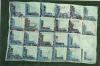
Log cabin quilt, machine pieced and assembled. Some fabrics are pieces from family dresses, with mauve crepe used throughout. The pale side of each block is silk taffeta and other silk pieces. Padding is flannelette, and backing is cream muslin from a petticoat of the present owner, worn when she was bridesmaid to an aunt and uncle. 1000 x 630 mm.
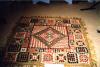
Patchwork quilt/cloth with strong overall design of very small squares. The colours are navy, red, cream, green (khaki) and fawn. There is a wide fringe on all sides. There is no padding. The backing is cotton sateen.
1240 x 126mm
1240 x 126mm
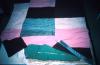
The top is machine pieced patches of used clothing. The backing is large pieces of dress materials and either end patches similar to the top. The padding is a chaff bag or similar with patches of worn, matted children's jumpers sewn directly on to it.
1400 x 1150mm
1400 x 1150mm