Quilt No.13JHS - Junee & District Historical Society
Junee & District Historical Society
Owner: 
Junee & District Historical Society
Location: 
NSW Riverina
Maker
Maker: 
Amelia Cuttle
Made in
ENGLAND
Date: 
1851 - 1880
Description: 
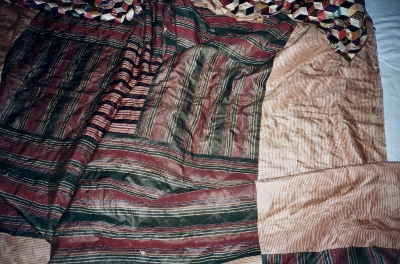
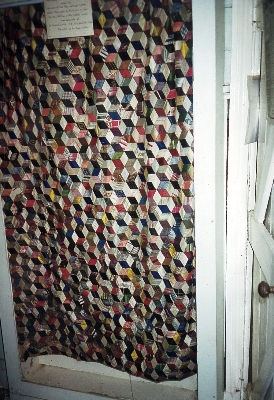
Pure silk hand sewn Tumbling Block quilt incorporating a great variety of silks in plains, florals and stripes. The backing is large rectangles of striped silks or polished cottons. It is hand quilted in a simple square cross hatch.
790 x 1470mm
History: 

The quilt was made in England by Amelia, the wife of the Reverend William Cuttle before they came to Australia. The Rev. William and Mrs Cuttle were grandparents of Dr. Ronald Cuttle. His wife Mrs Ronald Cuttle donated the quilt to the Junee and District Historical Society NSW.

Story: 

Label reads: 'Hand made box pattern patchwork quilt. Made in England by the wife of the Reverend William Cuttle before they came to Australia in 1884. The Rev. William and Mrs Cuttle were grandparents of Dr Ronald Cuttle M.B. B.S. (Melb) FRCS. Presented by Mrs Ronald Cuttle.'
"Enclosed is a photo of a Quilt which we have always believed came to Australia in March 1863 with my great grandparents - Rev William & Mrs Amelia Cuttle. Whether she made it on the way out, or had made it before she left, we are not sure. Unfortunately some parts of it have begun to deteriorate - it is made from mostly silk materials. Some years ago my mother gave it to the Junee Museum where it's displayed in a glass case which my mother provided for its protection. �..Rev William Cuttle came out from the Whitfield Tabernacle Congregational Church, Kingswood Bristol, to be minister of the Geelong (Vic) Congregational Church in 1863."
[Letter from Anne Carter, 1996]

Related Quilts:
National Gallery of Australia
" Reversible patchwork quilt of woollen suiting/upholstery fabrics in khaki, greys, blues and browns. Both sides have different designs. The front of the quilt has 13 rows of 12 vertical rectangles flanked on either side by a column of 22 horizontal rectangles. The reverse has a more interesting and complex design of small and very large rectangles, squares and triangles; with khaki contrasting with the duller greys and blues. The patchwork layers are joined at the edges with machine stitching and the quilt is machine quilted along 3 horizontal lines following joins in the patchwork; therefore not being totally straight. These lines are more noticeable on the reverse. The reverse face has been on display at the NGA." [NGA] There is a cotton blanket used as padding. 2054 x 1451mm
Margaret-Anne M Thomas
Cotton quilt hand pieced and hand quilted. Eigth pointed star on a white background. 7 rows of 7 stars with a 70mm border. There is a padding or interlining. The backing is plain off white cotton twill.
2040 x 2030mm
Phyllis Dowling
Hand pieced cot quilt made from small rectangular shapes of a great variety of materials including cottons, silks, wools and velvets. The backing is cotton sateen in 3 colours and is brought to the front to form a border of pink, cream and yellow.
1170 x 920mm
Win Adcock
The quilt on longer exists, just the label, but the quilt was squares of flannelette shirt material, velvets and woollen pieces. The backing was calico. The label was sewn to the backing and it reads: 'Red Cross Killarney Manitoba'. It is embroidered in red and is on a white piece of sheeting.
Ruth Flett
Quilt is made of wool tailors' samples, each measuring 6 x 3 1/2 inches. The colours are predominantly navy and grey. Most pieces are striped but some more distinctly than others. Both sides are mad eof smaples, one side being mainly grey and the other almost exclusively navy. There doesn't seem to be another layer of material as padding. There is no added decoration. Made on a treadle sewing machine.
1703 x 1423mm
National Gallery of Australia
" A wide range of cotton fabrics have been used to make this quilt in the traditional log cabin style. The strips of the log cabin are joined by rows being hand sewn onto a small square backing fabric, each square of strips has then been hand sewn together to form the quilt. The work is backed with a sateen printed fabric decorated with paisley design. A strip of the lining trims the edge of the front face of the quilt. The lining is attached with machine stitching. There are numerous tacking stitches that remain in the front face of the quilt. There are approx 9000 pieces in the quilt, most being only 5mm in width.
The quilt is of three layers because the strips of the log cabin are attached to a backing piece, and then the quilt is lined; however it is not padded." [NGA]