
Quilt No.158OHS - Omeo Historical Society
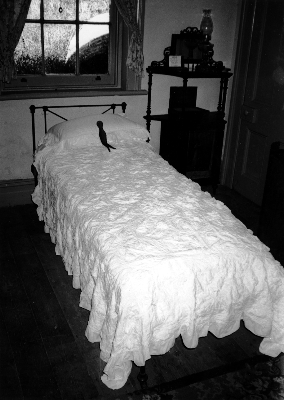
Description:
Quilt of white cotton octagonal patches made from bleached flour bags. Each patch has 8 segments which are stitched so that the middle of the segments puff up. Quilt has a frilled edging and a cotton backing.
It was made to suit a narrow single bed.
It was made to suit a narrow single bed.
History:
Made by Ada and Mary Pendergast, two of the daughters of Elizabeth Pendergast (Mrs John Pendergast) c.1890. Purchased by the Omeo Historical Society in 1973 at the Penders Court Homestead Clearing Sale.
Story:
"� Good information on the quilt is scarce. To the best of my knowledge the quilt was made by two of Mrs John Pendergast's daughters, Ada and Mary around the turn of the century. I have also enclosed some photocopies from Mrs Jane Vine Pendergast's book Pioneers of the Omeo District, which you may find helpful. The quilt itself does not seem to have any filling and its design is of octagons made up of pipe shape segments �"
[Brett.R.Lee Omeo Historical Society 22.1.96]
Brett advised later that the quilt is called a 'snow' quilt.
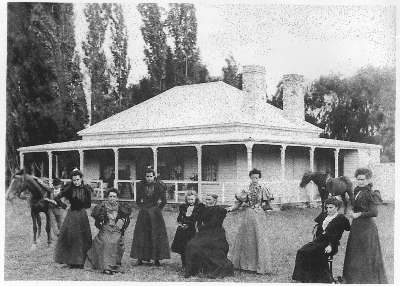
The Pendergast women at Pender's Court homestead
Related Quilts:
Patchwork quilt made up of 100mm multi coloured squares in a variety of materials including cottons, synthetics, lurex, plain and printed. Each square has dacron padding and is then joined in strips and the strips joined. All hand sewn. The backing is blue synthetic whole cloth 60mm of which is returned to the front to form a border.
1500 x 1200mm
1500 x 1200mm
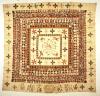
"The Rajah "quilt" is a patchwork and appliquéd bed cover or coverlet. It is in pieced medallion or framed style: a popular design style for quilts in the British Isles in the mid 1800's. There is a central field of white cotton decorated with appliquéd (in broderie perse) chintz birds and floral motifs. This central field is framed by 12 bands or strips of patchwork printed cotton. The quilt is finished at the outer edge by white cotton decorated with appliquéd daisies on three sides and inscription in cross stitch surrounded by floral chintz attached with broderie perse on the fourth side. All fabrics used in the Rajah quilt are cotton with the exception of small amounts of linen and silk threads. The quilt shows evidence of being produced by many hands." [NGA] The quilt is not padded or lined. 3372 x 3250mm
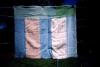
Small quilt made from pieces of heavy weight wooollen coat material cut into strips and machined together. It is reversible. Each side is made from different materials but in similar colours of aqua, blue, green and beige. The 2 layers are quilted together with a few machined lines of straight stitching. It has a folded and machine stitched edge. There is no padding.
950 x 790mm
950 x 790mm
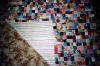
Suffolk puff quilt with each puff approximately 4cm x 4cm. The puffs are small squares rather than the more usual circles. Materials are mainly cottons and satins in a wide variety of colours and patterns. The backing is striped flannelette and is hand stitched to the top.
1660 x 1140mm
1660 x 1140mm
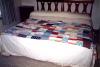
Cotton quilt, checks, plains and patterns. Machine construction. Rectangles stitched together in strips and then strips joined. The backing is a cotton print. There is no padding and no quilting.
2420 x 1220
2420 x 1220
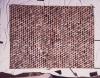
Double sided patchwork quilt. One side has small 'Tumbling Block' pattern. The other side has larger pattern of pieced stars. It is made of silks, some printed, some solid colours mainly blues, greens cream and black. There is no padding.
2100 x 1800mm
2100 x 1800mm