Quilt No.351GPM - Griffith Pioneer Park Museum
Griffith Pioneer Park Museum
Owner: 
Griffith Pioneer Park Museum
Location: 
NSW Riverina
Maker
Maker: 
Fanny Matilda Elliott
Made in
ENGLAND
Date: 
1881 - 1900
Description: 
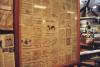
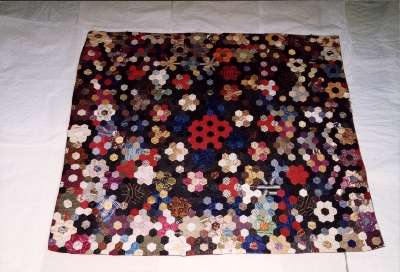
Patchwork quilt made from hexagon patches of cotton, silk, brocade, sateen and wool. Some silk patches are individually lined. Colours are mainly red, blues, purple, black, yellow and brown, with some pastels. Many silk patches have disintegrated, showing the paper templates. Quilt has a brown cotton inner lining, then a blue cotton backing, and is edged on the reverse with checked silk. Hand sewn by more than one person: one experienced sewer, one not so experienced.
1370 x 1170mm
History: 

Made in 1886 at Middleton Stoney, Oxfordshire, England, by Mrs Fanny Matilda Elliott (born East, 1860-1934). Previously owned by Fanny's daughter, Olive Avenell Scott (born Elliott, 1899-1991). Donated to the Griffith Pioneer Park Museum, Griffith NSW.

Story: 

Fanny Elliott's husband was a tailor, and the quilt was made from scraps from the Tailor's shop.
In 1923 Fanny's daughter Olive came to Australia and brought the quilt with her. She had met Mr Doug Scott in England during the war years (1916-1918) and they had struck up a relationship, so Olive came out to marry him.
Doug and Olive lived out on the farm at Lake Wyangan, which they had bought in the 1920s. The farm is run by their son Frank, who remembers the quilt being used on beds when he was growing up.
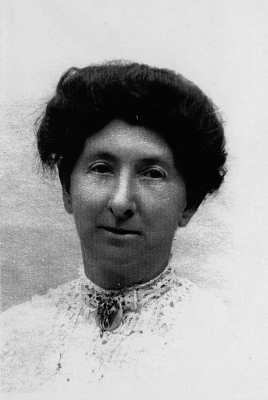
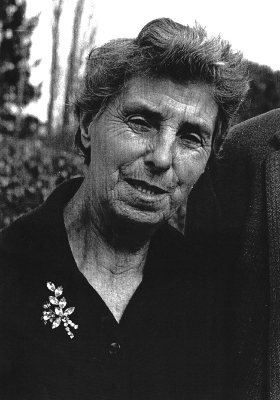
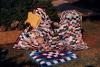
Fanny Matilda Elliott
Olive Avenell Scott
Olive Avenell Scott

Related Quilts:

June Johnson
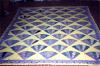
Hand sewn cotton cot quilt with pattern of red and white lozenge shaped hexagons measuring approximately 65mm from top to bottom. A centre flower is constructed from 2 circles of 19 hexagons in red and white. This is surrounded by 8 smaller hexagon flowers. Additional single red hexagons are scattered at random on the white background around the rows of flowers. The quilt is not quilted or tied but is attached at all 4 edges. Writing on the back of the quilt (probably added later) reads "Made by Sarah Hodge, Newport, Wales UK for her first child John." There is no padding and the backing is white cotton. 1000 x 1250 mm.
Helen Sparkman
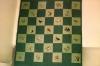
Hexagon quilt made from dressmaking scraps from one neice. The quilt top only is complete and a few papers are still attached.
2250 x 2000mm
Cobram Shire Historical Society
Patchwork quilt in Log Cabin pattern, arranged in 'furrows', and made from cottons, wool and suiting fabrics. Centres of blocks are pastel or dark; dark colours are black, brown, purple blue and red. Pastel side of blocks includes a bright pink. Quilt backing is pieced, with a centre rectangle of cotton surrounded by 5 borders of plain and alternate rectangular pieced strips, in wool and suiting fabrics. Colours are black, dark blue, brown, green, grey and pastels. Inner lining is of cotton pieces, to which the Log Cabin blocks have been machined.
1620 x 1360mm
Cressida Mary Webb Challis
Quilt of machine pieced squares and rectangles using a wide variety of materials in plain colours and patterns. It is one of a pair. There is no padding and the backing is 90cm strips of calico.
2500 x 2130mm
Julie Bos
Crazy patchwork quilt with pieces made from cottons, rayons, silks and taffetas. Each piece is stuffed with kapok and machine sewn to a backing then a wholecloth floral cotton backing has been added.
920 x 164o mms
National Gallery of Australia
" Reversible patchwork quilt of woollen suiting/upholstery fabrics in khaki, greys, blues and browns. Both sides have different designs. The front of the quilt has 13 rows of 12 vertical rectangles flanked on either side by a column of 22 horizontal rectangles. The reverse has a more interesting and complex design of small and very large rectangles, squares and triangles; with khaki contrasting with the duller greys and blues. The patchwork layers are joined at the edges with machine stitching and the quilt is machine quilted along 3 horizontal lines following joins in the patchwork; therefore not being totally straight. These lines are more noticeable on the reverse. The reverse face has been on display at the NGA." [NGA] There is a cotton blanket used as padding. 2054 x 1451mm