Quilt No.55GPM - Griffith Pioneer Park Museum
Griffith Pioneer Park Museum
Owner: 
Griffith Pioneer Park Museum
Location: 
NSW Riverina
Maker
Maker: 
Angela Zilliotto's mother
Made in
ITALY
Date: 
1921 - 1940
Description: 
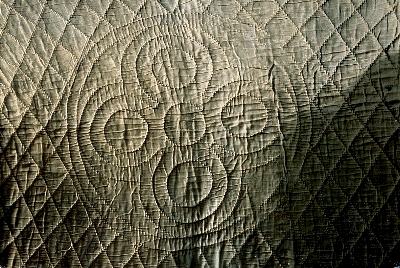
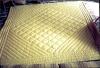
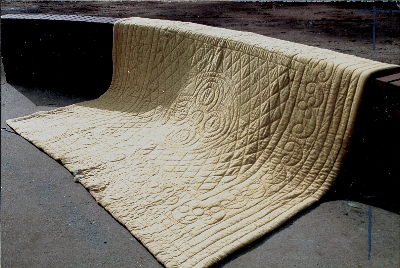
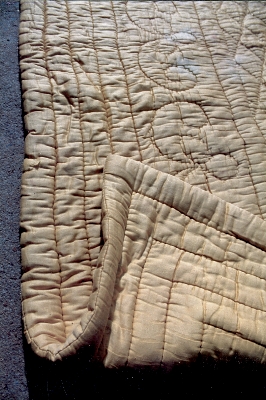
Wholecloth quilt, yellow sateen both sides. Hand quilted in geometric and curvilinear patterns. Edges turned in, hand finished. Stuffed with flock-like material said by the donor to be wool. Approximately 2.5cm thick.
2500 x 2000mm.
History: 

Brought to Australia in 1949 by Angela Zilliotto (born Torresan) 1915 - 1958 born at Crespano Del Grappa in the Veneto region of Northern Italy, possibly made by her mother.
Donated to Griffith Pioneer Park Museum by Angela's daughter, Nazzarina Zilliotto. Angela was the first wife of Milio Zilliotto.

Story: 

"Recently Poineer Park acquired an item of particular interest � It was a handmade quilt from Italy donated by Maria Zilliotto in the name of her mother, Mrs Angela Zilliotto... [who] � died in 1958. As far as Maria knows, her mother brought it to Australia when she came to join her husband, Milio Zilliotto, in Griffith in 1949. Angela had been a teacher in Venica, but because of her lack of English took up dressmaking here.
The quilt is thought to have been made by Angela's mother� Italian households, like that of Angela's family, used to keep a few sheep. When a quilt was required, often to mark a special occasion such as a daughter's wedding, the fleece were stored up over a period of time until there was sufficient for the filling. Before making the quilt, the wool was washed, treated and spread between lining layers. Then the lining sandwich, with top and bottom covers, was stretched out on a frame. Several quilters might work on the quilt at once, moving around the frame as necessary. If a family did not do their own quilting, they would employ a specialist home quilter.
The design of the Zilliotto quilt is also reminiscent of the British quilts that have survived. Like them, it is a wholecloth quilt, made from the same material throughout � It is made from cotton sateen � Also popular in Britain, and uses similar simple geometric and floral designs - with a very Celtic look to the central motif. Two other quilts at the Zilliotto home shared these features, with plainer geometric design.. �
Perhaps the most unusual feature of the Zilliotto quilts is their thickness. � ..The Italian quilts however are three to four centimetres thick. They must have been even thicker before they were quilted, and before years of use packed the filling down - very difficult to sew through � but very warm."
[Robyn Oliver, curator Griffith Pioneer Park Museum, article in The Area News 16.8.1993]
Related Quilts:
Yvonne Hamdorf
Wholecloth pram quilt with a top of pink cotton sateen, and the reverse is a more finely woven, ivory, fabric. All over quilting design as main feature, with stylised hearts, leaves and cross hatching. The padding is cotton batting. 870 x 660 mm.
John Tomkin
Hand stitched, cotton, appliquéd, quilt in a flower pattern on a plain background. Colours are shades of green, apricot and browns. This quilt was known as a 'Bride's Quilt'. Padding is thought to be layers of white fabric raised almost like a wadding. The backing is cotton material. 2470 x 2020 mm.
Guna Naoumidis
Wholecloth quilt made of gold satin with a backing of beige coloured cotton. The padding is wool. The quilting pattern is an all over diamond pattern, framed in a border of straight and wavy parallel lines. It is hand quilted.
2000 x 1820mm
Sharon Stacy
Wholecloth quilt of white cotton with hand appliqued flowers in 3 shades of red. The centre of the quilt has 6 separate flowers radiating from a circle and each corner has a separate arrangement of flowers. The white cotton quilting is in diagonal lines and a daisy pattern. There is a narrow red border widely scalloped. The backing is white cotton. There is no padding.
2236 x 1905mm
Alysoun Ryves
Red Applique on an off white background. All applique is by hand using herringbone stitch. Three different red materials are used for the applique each printed with a different tiny all over pattern. There are 3 different applique shapes: the 9 major shapes have 8 points; the daisy pattern has 8 petals; the edge pattern is used along the top, left and half of the bottom edge of the quilt and sometimes has 4 points, sometimes 3 and sometimes 2. There is a tiny red piping around the quilt along the bottom and both sides. It is hand quilted in 100mm long zig zags 12mms apart all over the quilt. The quilt is signed twice on the front, once in ink and once in embroidery. It is signed 'Anna Edwards Jan 1858'. There is no padding and the backing material is similar to the off white background material of the top.
2270 x 2180mm
Mary and Max Robertson
Traditional Wagga rug made from 3 wheat bags joined along the long side by sewing with bag needle and twine. Machined twill cover was put on later in the 1960s. Originally no padding but now the bags are the padding. One of a pair(identical).
1790 x 1160mm