
Quilt No.602PWH - The Pioneer Women's Hut

Owner:
The Pioneer Women's Hut
Location:
NSW Riverina
Maker
Maker:
Lucy Gallagher
Made in
AUSTRALIA NSW
Patterms
Date:
1941 - 1970
Description:
The top is machine pieced patches of used clothing. The backing is large pieces of dress materials and either end patches similar to the top. The padding is a chaff bag or similar with patches of worn, matted children's jumpers sewn directly on to it.
1400 x 1150mm
1400 x 1150mm
History:
This quilt was made by Lucy Gallagher at 'Eringoarrah' (a property near Wagga Wagga NSW) c.1940. It was one of many Lucy made for general use on beds. Lucy moved to Wagga after her husband Walter died and in 1986 donated the quilt to The Pioneer Women's Hut. It is occasionally displayed at the museum.
Story:
Lucy's husband Walter (deceased) worked as a general labourer at 'Eringoarrah', a large property near Wagga Wagga, for 39 years. Lucy identified where most of the patches came from: "That's part of Mr. Sawyer's overcoat" (Mr. Sawyer was the owner), "That's part of dear Mrs. Wishart's frock". Lucy referred to it as a Wagga rug.
Related Quilts:
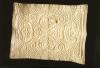
Wholecloth pram quilt with a top of pink cotton sateen, and the reverse is a more finely woven, ivory, fabric. All over quilting design as main feature, with stylised hearts, leaves and cross hatching. The padding is cotton batting. 870 x 660 mm.
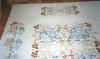
Hand stitched, cotton, appliquéd, quilt in a flower pattern on a plain background. Colours are shades of green, apricot and browns. This quilt was known as a 'Bride's Quilt'. Padding is thought to be layers of white fabric raised almost like a wadding. The backing is cotton material. 2470 x 2020 mm.
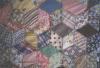
Cotton patchwork quilt in an all over pattern of diamonds in a wide variety of patterned and plain materials. Many seams are oversewn in feather stitch which goes through to the backing of calico.
1625 x 925mm
1625 x 925mm
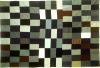
" Reversible patchwork quilt of woollen suiting in grey, blue, navy, maroon and brown. The fabrics appear to be new tailor's sample pieces (the sizing is still present on the fabric, signifying it has never been washed). The patches are rectangular and vary in size. Both sides have different designs. The front of the quilt has 4 rows of 12 vertical rectangles then below this are 4 rows of 7 horizontal rectangles followed below by 4 rows of 11 vertical rectangles. The reverse of the quilt has a section at the top and bottom composed of 5 rows of 9 horizontal rectangles. The central area is made up of a centre section of 6 rows of 5 vertical rectangles; flanked on either side by a column of 10 horizontal rectangles and two columns of 8 smaller vertical rectangles.
The patchwork layers are joined at the edges with machine stitching. The patchwork layers and padding are machine quilted on the front down 2 vertical lines following joins in the patchwork; therefore not being totally straight. The lines are more noticeable on the reverse as the 2 sides do not match. The front face is displayed at the NGA.
Between the patchwork layers is a striped cotton blanket in black, sky blue, white and cream." [NGA]
2082 x 1386mm

Old jute wool pack opened out and joined together selvedge to selvedge. Ends bound with recycled curtain material.
1550 x 1321mm
1550 x 1321mm
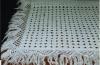
" Double bed size coverlet made of white cotton 'blue bags' fabric (white cotton squares used to hold a measured amount of blueing agent used to keep linens white during the laundering process). Patches are sewn together in the 'Suffold Puff' style - a circle of fabric is gathered up to make a puff. Patches are joined by a few stitches on four sides. Coverlet is edged with a deep crochet fringe, to a depth of approx. 18cm on all four sides���On lining is written in black ink: 'C.Bleagard Baby Ken'. " [NT NSW]
2570 x 2380mm
2570 x 2380mm