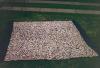
Quilt No.651TRM - The Temora Rural Museum
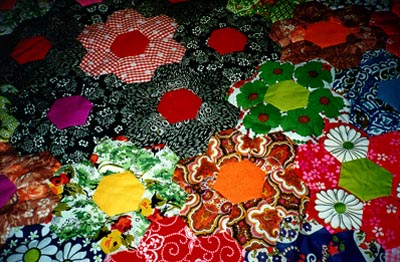
The Temora Rural Museum
Owner: 
The Temora Rural Museum
Location: 
NSW Riverina
Maker
Maker: 
Sylvia Schleibs
Made in
AUSTRALIA NSW
Date: 
1941 - 1970
Description: 
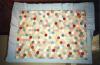
All cotton hexagon quilt using a wide variety of colours and patterns. The hexagons were hand stitched by Sylvia Schleibs in the same style she and her daughter, Norma Gilchrist, had previously made 3 hexagon quilts. There is a calico border and backing.
2000 x 1450mm
History: 

This quilt was part made by Sylvia Schleibs in the Temora district NSW in the 1960s. In 1981 Sylvia's daughter, Norma Gilchrist, gave the hexagons to the Temora Rural Museum and in 1996 Marj Brown (the curator) completed the quilt by stitching the hexagons together and adding a calico border and backing.

Story: 

Sylvia Schleibs was a typical farmer's wife with many interests and commitments including milking the cows and tending a large flock of chooks. She sold butter and eggs and violets, sewed, was a good cook and was practical and thrifty. She and Norma (daughter) only made hexagon quilts.
Marj Brown grew up on a farm and also married a farmer. Her interest in needlework was a great help to her in making her own and the children's clothes. She retired to Temora in 1982 where she became interested in the Rural Museum and became curator in September 1995. Her knowledge of needlework was a great help to her in repairing and finishing articles that were in storage. She likes doing tatting, crochet, knitting and embroidery of all types.

Related Quilts:
National Gallery of Australia
" Reversible patchwork quilt of woollen suiting/upholstery fabrics in khaki, greys, blues and browns. Both sides have different designs. The front of the quilt has 13 rows of 12 vertical rectangles flanked on either side by a column of 22 horizontal rectangles. The reverse has a more interesting and complex design of small and very large rectangles, squares and triangles; with khaki contrasting with the duller greys and blues. The patchwork layers are joined at the edges with machine stitching and the quilt is machine quilted along 3 horizontal lines following joins in the patchwork; therefore not being totally straight. These lines are more noticeable on the reverse. The reverse face has been on display at the NGA." [NGA] There is a cotton blanket used as padding. 2054 x 1451mm
Arlene Crane
Cotton patchwork quilt in double wedding ring pattern in pastel prints. Quilted in a design of geometric flowers. Padding is probably cotton wadding, backing is cream calico. 2270 x 1970 mm.
Phyllis Dowling
Hand pieced cot quilt made from small rectangular shapes of a great variety of materials including cottons, silks, wools and velvets. The backing is cotton sateen in 3 colours and is brought to the front to form a border of pink, cream and yellow.
1170 x 920mm
Art Gallery of South Australia
Frame cot quilt in cotton fabrics, the centre square in a paisley print surrounded by two plain borders or frames, then two frames pieced in alternate light and dark triangles, then a frame in a floral print. Outer border is of red fabric, longer at top and bottom to make a rectangle. No quilting. Machine sewn.
1050 x 770mm
Alyce Wright
Cotton scrap quilt in a pattern known as 'Grandmothers Fan'. It is hand quilted. The padding is hand carded cotton and the backing is muslin.
2235 x 1880mm
National Trust of Australia (TAS)
Small rectangular bed cover, probably child's or even doll's, made from rectangles of cream linen stitched together with hand sewn french seams. The top surface is decorated with small squares and rectangles of coloured silk, velvet, wool and cotton attached approximately 25mm apart, with 3 stitches in centre of patch to attach to background. Bright pink wool patches stand out.
935 x 635mm