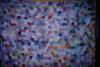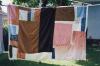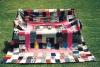
Quilt No.663CR - Constance Real

Constance Real
Owner: 
Constance Real
Location: 
QLD South East
Maker
Maker: 
Constance Real
Made in
AUSTRALIA QLD
Date: 
1941 - 1970
Description: 
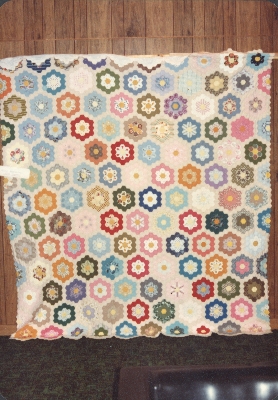
Quilt of hand sewn cotton hexagons arranged in rosettes or 'flowers'. The padding is seedless cotton imported from America and the backing is madapolin. The scraps for the hexagons came from old dresses and especially from the owner's children's clothes.
2591 x 2337mm
History: 

Constance Real made this hexagon quilt in Kingaroy Queensland c.1960 and she is still the owner.

Story: 

Connie Real started quilting in the 1950s. "She knew nothing about the craft and started from scratch." In the 1960s Connie was influenced by an article in the New Idea magazine on Mrs. Bland a Canadian woman married to an Englishman and living in Melbourne. The article promoted quilting and referred to American designs such as 'Ohio Rose', 'Triple Sunflower', 'Daddy Hex' and 'Double Wedding Ring'.
"In the 1970s interest was growing in Queensland and as people saw Connie's work they too wanted to know how to do it. Interest was also stimulated through CWA meetings and eventually in 1978 Connie began the first patchwork group in the Darling Downs when she was asked to tutor a full and enthusiastic class at the Summer school in Toowoomba. A further class was begun by Connie in her home town of Kingaroy in 1980. Due to her enthusiasm and strong direction a very strong group was established there and in the surrounding districts. These are alive and flourishing today, regularly attracting new devotees to a wonderful craft. Over the years Connie can count back to a figure of 200 women who have joined her group enjoying what she calls 'this fabulous pastime'. Connie is an original member of the Queensland Quilters Inc. which began in 1984 as an organisational guild for meetings in Brisbane, becoming the Queensland Quilters Inc. in 1988."
[Extract from notes from a friend of Constance Real, Qld, 1998]
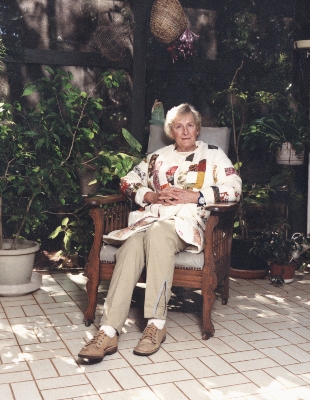
Constance Real 1998
Constance Real 1998

Related Quilts:

Annette Gero
This quilt is of hand pieced hexagons randomly placed and stitched on to a linen backing. They are mainly dress fabrics and chintz with some hexagon flowers in the centre and corners in broderie perse. There is no padding.
2600 x 2600mm
National Trust of Australia (NSW)
Quilt of small silk and rayon rosettes of hexagons in prints and plain materials including velvet, voided velvet, chine, printed silk, brocades, taffeta, satin, crepes. Many of the materials are from Japanese kimono and wrapping silks. It is pieced over papers, one paper has a typed date '1930'. The backing is black silk satin and is turned to the front to form a border.
1695 x 1390mm
Barbara McCabe
Patchwork quilt made from squares of cotton fabrics, from curtains, left over from dress making projects, and new fabrics. Colours are bright primaries and some pastels, prints are checks, florals, stripes and plain. Pieces were stitched together without any particular order. No padding or quilting. Backing is a cotton bedspread in turquoise and blue stripes.
2520 x 1600mm
Barbara McCabe
Patchwork quilt made from rectangles and squares of woollen fabrics from dress making projects. Colours are mainly grey, blue, brown, green, with some red and yellow. Fabrics are plain, cheks and stripes. No padding or quilting. Backing is made of white flannelette sheets. The quilt has been lengthened after it was completed, and the backing sheet has been added to at the same place.
2470 x 1320mm
Lyn Uppill
Patchwork quilt of hexagons, handsewn, in print and plain cottons and rayon. Central star group has diamond shaped groups of patches, with smaller flower shapes, an inner border of a star shape in yellow hexagons, and an outer border of hexagons in vertical bands. Colours are mainly blues, reds, greens and yellow, the 'paths' and border are a pink print. The backing is herringbone stitched to the border or sashing, which has mitred corners.
2400 x 2340mm
National Gallery of Australia
"This quilt follows the traditional hexagon patchwork pieced pattern, which are then joined and sometimes edged with a contrasting border. The edges of the quilt have been turned and then scalloped edges made of identical patches to the main body of the quilt have been attached to the edge. The quilt is fully lined, and the lining is visible front the front face through the gaps between the scalloped edge. The lining is attached to the patchwork with a row of stitches along the edges; there are no stitches in the centre field. The fabrics of the quilt are plain weave cotton in simple floral and geometric designs. Most of the fabrics are monochromatic. Several different colour ways of the same fabric are evident which could suggest some fabrics were from manufacturer samples. The lining is a William Morris print.
Each of the patchwork pieces (there are several thousand present) are sewn together with very fine overcasting stitches. The quilt is entirely hand sewn. There is some evidence that templates from the hexagon pieces possibly blotting paper, remain in situ���The quilt is not padded or quilted. The lining is fine twill weave cotton printed in pink and pale purple. The design follows William Morris's 'Strawberry Thief design'." [NGA] 2075 x 1911mm