Quilt No.71MC - Mare Carter

Mare Carter
Owner: 
Mare Carter
Location: 
NSW South East
Maker
Maker: 
Eva Leota Towe
Made in
USA
Date: 
1921 - 1940
Description: 
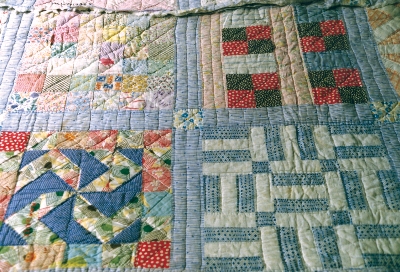
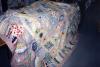
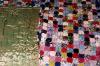
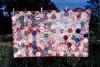
Friendship Quilt'. All cotton with thick cotton padding. Each of the large panels of patchwork is different and many are signed by the makers who belonged to the Rebecca Lodge in Linwood California. Dates on the squares with signatures are 1933. Wide variety of colours and patterned and plain fabrics. The quilt is now in 2 pieces.
1981 x 1727mm
History: 

Eva Leota Towe belonged to the Rebecca Lodge in southern California and social quilting was a regular pastime. This 'Friendship' quilt was made by Eva and members of the Lodge. Mare Carter (grand-daughter) came to Australia in 1950. In 1953 Eva died. "In 1960 my Mother brought me grandmother's legacy, her hand-works including the quilts" when she visited Australia. Most of the quilts have been family quilts and well used.

Story: 

"VINTAGE QUILTS 1898-1938
These quilts were made by my grandmother, Eva Leota Towe. Her maiden name was Tussey and she came from Missouri, U.S.A. In early 1900 grandmother moved to Washington State and later to Southern California.
Patchwork was our family tradition. It provided a frugal means to "dress" a home and to make cosy beds which were also pretty. I rarely saw grandmother without her bag of patches and templates handy, rarely saw her sitting idle; usually while chatting or listening to the radio, she'd be quietly piecing together patches which were cut mostly from used garments. Her scissors were kept sharp by my grandfather, she wore out countless thimbles, her needles were regularly pushed in and out of a little sock of sand to ginger up their points. The actual quilting was often done in company with friends who belonged to the Rebecca Lodge. At least one of these quilts is a Friendship Quilt made and signed by those women in 1933.
Grandmother also embroidered, to decorate her tables, her aprons and also her tea-towels which were always made from bleached flour sacks. It embarrassed my Mother and her sister that their underclothes were made from the same materials. Maybe this is why sewing and handcrafts skipped a generation in my family. The contribution my mother made was to keep these things safe and gradually pass them along to me.
My children suffered from allergies. Wool was too itchy, and too hot. The cotton quilts of my grandmother were perfect for our beds here in Australia. Thus we used our legacy to good purpose. Sadly, most of the quilts are now tattered and worn, but much loved for that, and for the affection which she sewed into them. She never made things to be preserved as objects of art. They represent her creativity, her duty as a woman and a home-maker, and her principle means of recreation and sociability."
[Mare Carter, Foxground 1998]
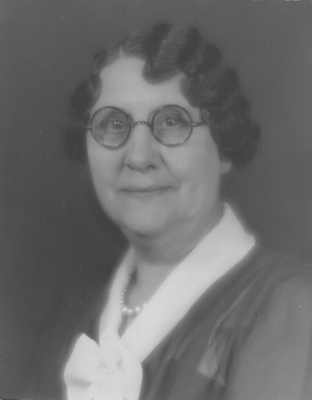
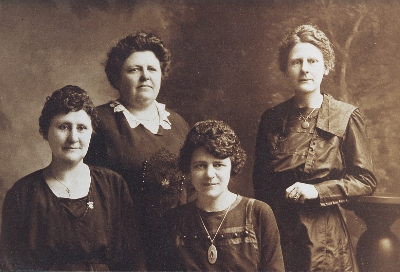
Eva Leota Towe c 1940

Related Quilts:

National Gallery of Australia
"The quilt consists of 12 blocks of crazy patchwork with an embroidered border. The quilt is made of 167 different fabrics; most of these are silk. These velvets, printed silks and satins are beautifully embroidered with flowers, household items and Kate Greenway images of children at play. Many of the motifs have a strong influence from the Aesthetic Movement. The edge of the quilt carries a border in maroon silk decorated with tendrils and daisies in very fine embroidery.
The patches are joined with hand sewing and embroidery, however the 12 panels are joined with machine stitching (chainstitch machine stitching). The blue silk lining was hand sewn into position with silk thread." [NGA]
"The quilt does consist of three layers but the central layer is not padding. The crazy patch pieces were sewn together and this was lined with white cotton fabric prior to the embroidery at the edges of the 12 panels being placed. This in turn was lined with a fine blue silk." [NGA] 1810 x 1460 mm
Gillian Sullivan
Quilt made of 9120 very small Suffolk Puffs, each one about the size of a 20 cent piece. "Each piece backed and the front of it drawn up like a reticule. It was not backed and was rather fragile, so I backed it on to a sheet, as it was heavy and in danger of tearing when lifted." [Gillian Sullivan]
2360 x 2230 mm
National Trust of Australia (WA)
Patchwork quilt in Grandmother's Flower Garden pattern, consisting of 7 patch rosettes with white 'paths'. Cotton dress and shirting materials have been used in blues, pinks, brown, turkey red and Prussian blue. The quilt is hand sewn and each hexagon is 25mm wide. The backing is cream twill cotton in three panels. There is a hand sewn binding in red/pink cotton. There is overall quilting in chevron or zigzag pattern.
2415 x 2110mm
Kerrie Maloney
Double sided quilt made from woollen suiting pieces some of which have hand worked eyelets. Many of the rectangles are irregular. Both sides use similar pieces but arranged in different patterns. There is no padding.
2160 x 1524mm
Meg Orr
All over pattern of rows of hexagons with each unit made up of 4 hexagons each 45mm. Patterned and plain materials thought to date from the 1930s including cotton and linen dress materials, synthetics and synthetic crepe. It was an unfinished top and Meg Orr, the present owner, finished it by machine stitching some of the hexagon rosettes to the red twill background and stitching on a backing. There is no padding.
1740 x 1210mm.
National Gallery of Australia
" A wide range of cotton fabrics have been used to make this quilt in the traditional log cabin style. The strips of the log cabin are joined by rows being hand sewn onto a small square backing fabric, each square of strips has then been hand sewn together to form the quilt. The work is backed with a sateen printed fabric decorated with paisley design. A strip of the lining trims the edge of the front face of the quilt. The lining is attached with machine stitching. There are numerous tacking stitches that remain in the front face of the quilt. There are approx 9000 pieces in the quilt, most being only 5mm in width.
The quilt is of three layers because the strips of the log cabin are attached to a backing piece, and then the quilt is lined; however it is not padded." [NGA]