
Quilt No.811QVM - Queen Victoria Museum and Art Gallery
Owner:
Queen Victoria Museum and Art Gallery
Location:
TAS
Maker
Maker:
Unknown
Made in
WALES
Date:
1851 - 1880
Description:
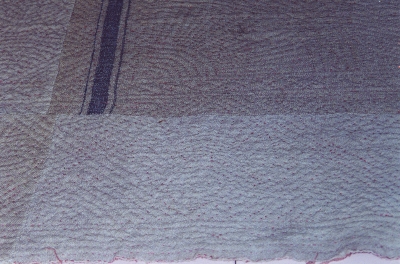
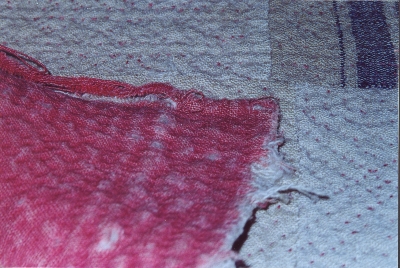
Wholecloth quilt with one side cream wool and one side faded red wool. Red wool is joined with 3 seams by loom length; red appears to be cochineal dyed. Cream wool side appears to have been made from a hand woven blanket with blue selvidge on 2 sides. It is hand quilted in red wool thread; Welsh patterns including clamshell, Welsh pear, snail or spiral. Centre frame has 2 cable borders and the centre corners have fans. The outer quilted border has alternate 4 petal flowers, clamshell, and spirals.
It is padded with hand carded wool.
1950 x 1935mm
It is padded with hand carded wool.
1950 x 1935mm
History:
The maker is unknown but the quilt was made in Wales c. 1850 -1870. It was given to William Thomas Huxley and his wife Laura (born Ludbery) when their home and contents were destroyed by bushfires that swept through Anderson's road lower Longley Tasmania in the late 1880s. It then passed to their grand-daughter Miss Essie Huxley of 'Telopea' lower Longley who gave it to Yvonne Hamdorf. Yvonne donated it to the Queen Victoria Museum and Art Gallery in 1997.
Related Quilts:
Wholecloth pram quilt with a top of pink cotton sateen, and the reverse is a more finely woven, ivory, fabric. All over quilting design as main feature, with stylised hearts, leaves and cross hatching. The padding is cotton batting. 870 x 660 mm.
Hand stitched, cotton, appliquéd, quilt in a flower pattern on a plain background. Colours are shades of green, apricot and browns. This quilt was known as a 'Bride's Quilt'. Padding is thought to be layers of white fabric raised almost like a wadding. The backing is cotton material. 2470 x 2020 mm.
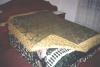
Traditional hand stitched Greek quilt, the top piece (in Greek a 'Stoffa') is of blue brocade with a gold pattern of roses and leaves. The border and backing are made from gold brocade woven with a daisy pattern (the same material as is in sister Ann Kyranis' quilt). The padding is cotton wool.
2100 x 1740mm
2100 x 1740mm
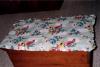
Rectangular cot quilt of green floral cretonne with pleated frill. Machine made. The backing is the same material. It is tied not quilted. The padding is old woollen jumpers.
1050 x 610mm
1050 x 610mm
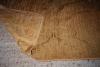
Wholecloth quilt made from rayon/damask style fabric golden brown in colour with a raised stylised floral motif. Quilted to the self pattern of the fabric. Hand quilted, backing is of gold coloured fabric.
Cotton wadding showing through worn areas.
1810 x 1250mm
Cotton wadding showing through worn areas.
1810 x 1250mm
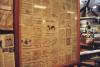
World' quilt of linen squares , autographed, embroidered in stranded cotton and the squares sewn together.
2000 x 2000mm
2000 x 2000mm