Quilt No.862AG - Annette Gero

Annette Gero
Owner: 
Annette Gero
Location: 
NSW Sydney
Maker
Maker: 
Gil Jackson
Made in
AUSTRALIA NSW
Date: 
1921 - 1940
Description: 
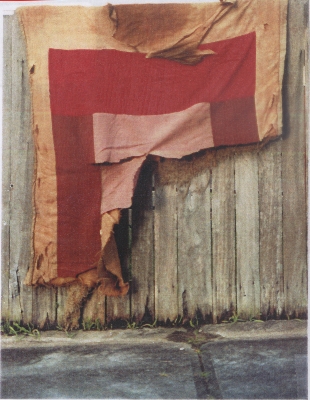
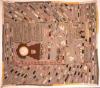
Domestic Wagga made from wheat bags sewn together and covered with large pieces of material.
1400 x 1230mm
History: 

This domestic Wagga rug was made by Gil Jackson (1906-1995) in the Nowra district NSW c.1926. It is now in the collection of Annette Gero.

Story: 

"Gil was the second eldest son of a family of four sons from Gloucestershire. He always had a hankering to see more of the World. Read about the 'Dreadnought Scheme' and applied for assisted passage. When first arriving in Australia in 1925, Gil, like every 'boy' who came out from England with the 'Dreadnought Scheme' was sent to Scheyville Farm up the north coast and trained in farming.
After three months at Scheyville, Gil was sent to Nowra, to Murphy's farm, at Lower Nimba. This is where he made the 'Wagga' quilt. He certainly didn't have many possessions at this stage. 'Murphys' was a happy place, a big family of three boys and three girls.
After three years in Nowra, wishing to better himself, he moved to Sydney. He had a rough time getting permanent work, tried all sorts, when things got really tough with the depression, he 'humped his bluey' and took to the road.
During his stay in Sydney he stayed in many cheap boarding houses. He met his first wife during this time. The woollen fabric may have been her shirt and there is also a small child's dress covering the original hessian bags. The wagga must have been special to him as he kept it till his death in 1995." [Annette Gero]

Related Quilts:
E Shuttle
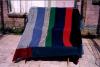
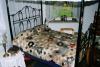
Wholecloth quilt made from orange cotton cretonne for back and front. Padding is made from old blankets stitched together. The quilt weighs 16 lb.
1423 x 1118mm
National Gallery of Australia
"This is not a true quilt, but a pieced coverlet with a lining. The entire front face of the quilt is of pieced hexagonal and part hexagonal printed cotton patches. Pieces are joined with hand sewn over casting stitches of many different coloured cotton threads. The joining of the patches forms a 'daisy' pattern in some areas and in others it is random. The edge of the front face of the quilt carries a 40mm strip of cotton Chinoiserie which is then folded to the reverse of the quilt and becomes part of the lining. The template for the hexagon patches remains in many of the patches: writing paper and news print." [NGA]
The work is not padded "The lining at the edge of the quilt (for approx.175mm) is a plain weave fabric of a Chinoiserie design. The centre field of the lining is a rectangular panel of a twill weave brushed cotton fabric with a striped floral design." [NGA] 2215 x 2070mm
Mare Carter
Patchwork quilt, all cotton including cotton filling. "8 pointed star" with turkey red surround, white background. Hand stitched and hand quilted.
2109 X 1727mm
The Pioneer Women's Hut
Machine constructed log cabin quilt using a wide variety of strips of used clothing including cottons, men's suitings and wools. Each square is about 250mm and arranged in the 'light and dark of the fire' variation of log cabin. There is no padding. The backing is brown twill with an orange pattern and is probably a replacement backing.
2180 x 1710mm
Win Oliver
Crazy patchwork quilt made from silk, brocade and velvet pieces, the seams covered with feather stitching in yellow silk. Fabrics are plain, and patterned with tartans, woven spots, stripes and floral brocade. Colours are rich, mainly red, pink, blue, green and cream. Quilt has a patterned velvet or velour border with urns and flowers in pale olive green and black, edged with a fringe in these colours.
1090 x 1040mm
Powerhouse Museum
"A tied patchwork wagga quilt made from swatches of men's wool suiting fabrics in blue/grey and pink/brown tonings. Rectangular swatches have been cut in half diagonally, and the resulting right-angled triangles paired to form larger equilateral triangles which alternate dark with light across the field. The quilt has been machine and hand pieced, then machined in vertical stripes.
The centre field is bounded by two strip-pieced borders at top and bottom, and three down each side. These are sewn from rectangles, using light pink/brown tones for the inner border and darker colours for the outer borders. The quilt is padded and backed and the side seams are secured with black herringbone stitch. The three layers are tied together invisibly with lazy daisy stitches in black cotton from the back." [PHM] The padding is a wool blanket and the backing is two pieces of cream twill cotton.
2030 x 1440mm