
Quilt No.870AG - Annette Gero
Owner:
Annette Gero
Location:
NSW Sydney
Maker
Maker:
Unknown
Made in
ENGLAND
Patterms
Date:
1881 - 1900
Description:
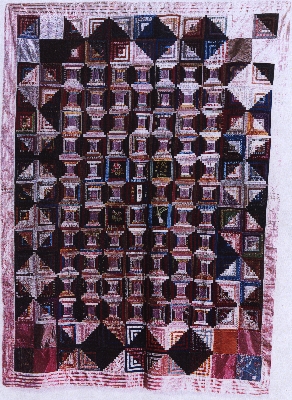
Hand pieced silk log cabin quilt. "The centre of this log cabin contains three ribbons, each with a crown, Queen Victoria and the date 1887. The four surrounding blocks contain the rose, the shamrock, the thistle and the leek, representing England, Ireland, Scotland and Wales." [Annette Gero]
2250 x 1680mm
2250 x 1680mm
History:
The maker is unknown. It was made about 1887.
This quilt is now in the collection of Annette Gero.
Story:
"Queen Victoria's Jubilee was a year of celebration in both England and Australia. As one Australian quilt maker says in her diary of 1887, 'I left home [London] at the end of November. It was Queen Victoria's Jubilee. I left London all decorated and I arrived in Sydney all decorated [for the Jubilee]'. Many patchwork quilts were made to celebrate the Jubilee." [Annette Gero]
Related Quilts:
Crazy patchwork quilt with patches of velvet, satin and silk joined in 12 blocks. Each seam is embroidered and many patches have embroidered flowers. There is a 140mm maroon velvet border. The backing is maroon silk. There is a sachet that belongs with the quilt.
1800 x 1400mm
1800 x 1400mm

Hand pieced hexagon quilt in pattern known as 'Grandmother's Flower Garden". 12 hexagons, in patterned cottons, form the outer border of each flower with an inner border of 6 matching plain coloured hexagons and all flowers have a yellow hexagon centre. There is no padding, a cotton backing and it is hand quilted.
2400 x 1780mm.
2400 x 1780mm.
Patchwork quilt in Log Cabin pattern made from silks, velvet, cottons and taffetas, in prints and plain, around a centre squares of black velvet. Colours are, in the dark sections, blues, greens, browns, yellow and pinks. The base of the blocks is blue and white ticking. The padding is probably cotton. Backing is of green cotton. There is an attached frill on all sides of green cotton, faded to dull light brown.
1630 x 1350mm
1630 x 1350mm
Patchwork quilt of rectangular wool and cotton tailors' samples, in browns, greys, navy, black and beige, in plains and patterned weaves. Padding is a woollen blanket, and the backing is a patterned cotton.
1956 x 1702mm
1956 x 1702mm
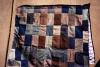
Patchwork quilt made from pure wool suiting samples in shades of navy blue and brown. Quilt is constructed in 11 rows containing 11 pieces. Each piece is 14cm x 9cm. No padding. Backing is of mauve cotton with a floral pattern of closely spaces white/pale mauve flowers.
1480 x 900mm
1480 x 900mm
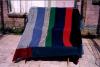
This quilt has been strip pieced with no regular pattern. It seems a large quilt has been made then folded in half. The materials used are woollen skirting pieces in a variety of colours. It could be used either way. There is no padding and it is very heavy.
2100 x 1950mm
2100 x 1950mm