Quilt No.905CFM - Carbethan Folk Museum
Carbethan Folk Museum
Owner: 
Carbethan Folk Museum
Location: 
QLD South West
Maker
Maker: 
Ellen Smith
Made in
AUSTRALIA SA
Date: 
1881 - 1900
Description: 
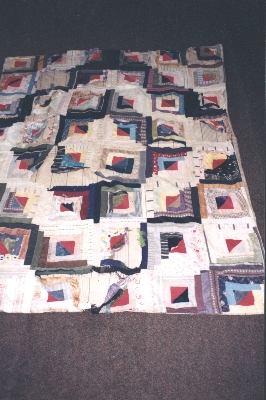
Patchwork quilt in a variation of Log Cabin. The materials are cotton and cotton velveteen. The backing is twill cotton ticking. There is no padding.
1499 x 1169mm.
History: 

Ellen Smith made the quilt at Nairne South Australia probably about the turn of the century. The family moved from Nairne to Crows Nest in Queensland. Fred Smith, Ellen's son, went to SA to visit his family and brought the quilt back in the 1930s. Fred gave it to his daughter Beryl Deeth (Smith) who donated it to the Carbethan Folk Museum at Crows Nest Queensland.

Story: 

"Ellen [Haines] arrived from England on her 17th birthday, the 8th May 1850, on the 'Lysander'. She later married the bullock driver who transported her from port Adelaide to her brother (Perc)'s place at Nairne. They arrived at 2 a.m. in the morning and Ellen's sister in law just moved over in her bed to make room for her that night. She and Mr Hillman [her first husband] had a son who died, and is buried near the forked gum tree in Nairn cemeteery and Mr. Hillman also died from injuries received in an accident, and is buried in the Hillman vault in Nainre cemetery." [Extract Geneology of John Smith by Dawn Foote]
Edis Smith was born in 1827 in England and arrived at Port Adelaide on the 'Star Queen' in 1854. He and Ellen Hillman were married in 1857 and they had twelve children: Emily, Mary Sophia, Rebecca, Zilla, Frederick, Rosina, Hephzibah, Elizabeth Amy, Isabella Annie, Albert Edis, Martha, Herbert Edis. It is said Ellen made a quilt for each daughter.
Ellen was a deeply pious woman and with Edis (a lay preacher for 50 years) helped build the Nairne Wesleyan Church. She died in 1916 aged 83. [Source of information, geneology of John Smith]
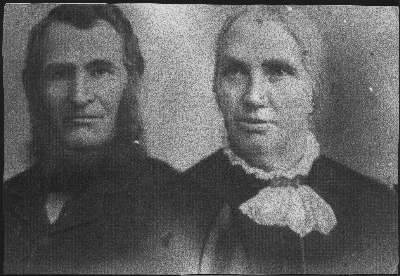
Edis and Ellen Smith

Related Quilts:

Fay Burgess
Hexagonal piece of patchwork made up of 9 rows of rosettes of hexagons in a wide variety of colours and patterns mainly in silks and velvets. It is incomplete. Backing papers are still in the outside rows and also basting threads. Hexagons are joined by fine whip stitching. It is unlined.
1370 x 1220mm
Muriel Hartmann
Reused parts of hand knitted woollen jumpers patched together. Wide crocheted edge from wool unravelled from jumpers retrieved from the tip.
1905 x 1525mm
Brenda Bird
Suffolk Puff quilt made from a variety of scraps of dress materials including cottons and terylene. It is backed with white cotton sheeting and edged with a frill of white terylene. There is a matching pillow sham.
1740 x 1300 mm.
N.S.W. Parks and Wildlife Service
Double sided quilt. Side 1 has an off centre frame based on a hexagon and including triangles and squares in a concentric pattern. The borders are all small rectangles with a single strip of large rectangles at one end. Side 2 has a central patch of pieced shapes appliqued to the background. The borders are squares and rectangles many in striped shirting cotton. Side 1 has minimal quilting to the interlining but it does not go through to side 2. The padding is a thin sheet.
The circle (sometimes pieced hexagons) is common to other 'Craigmoor' quilts.

1450 x 1230mm
Ruth Flett
Quilt is made of wool tailors' samples, each measuring 6 x 3 1/2 inches. The colours are predominantly navy and grey. Most pieces are striped but some more distinctly than others. Both sides are mad eof smaples, one side being mainly grey and the other almost exclusively navy. There doesn't seem to be another layer of material as padding. There is no added decoration. Made on a treadle sewing machine.
1703 x 1423mm
Lesley Stocker
Suffolk puff quilt with puffs in a variety of fabrics. Very little cotton. Fabrics are satin, polyester, organza, wool (now moth eaten), rayon and silk. There is no padding or backing. 2450 x 2100mm