Quilt No.962NGA - National Gallery of Australia

Owner: 
National Gallery of Australia
Location: 
ACT
Maker
Maker: 
Frances Baker
Made in
AUSTRALIA NSW
Date: 
1921 - 1940
Description: 
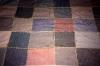
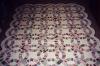
The front face of this quilt consists of rows of rectangles and squares of multicoloured prints pieced together. The fabrics are cotton and include a few early synthetics such as rayon, and all work is machined. The back is fully lined with an olive green moire synthetic fabric. The lining has been brought around to the front face of the quilt for approx 5cm to provide an edge border. The quilt is a wonderful showcase of the fabrics of the 20's and 30's." [NGA]
The quilt is not padded. 2160 x 1910 mm
History: 

The quilt was made by Frances Baker in Granville NSW. The National Gallery of Australia purchased it from its owner in NSW in 1992.

Story: 

"Mrs. Frances Baker nee Garnett (1879-1958) was born in Yorkshire, Great Britain and died in Granville, New South Wales. Her parents came to Australia in 1883 and, two years later, Frances and her brother arrived to join them. The family settled in Parramatta.
In 1908 Frances married Edward A. Baker of Granville. Rheumatic fever contracted in 1912 left Frances with a severe arthritic condition. Frances continued to sew, using one of the earliest electric sewing machines that she had bought before her marriage and later, had fitted with a knee control. She could handle small pieces of material and thus the patchwork quilts came into being. Frances used the leftovers from various dresses and she made all her quilts by 1938. This work was made in Granville.

Related Quilts:
Ruth Hansen
Cotton patchwork quilt in an all over pattern of diamonds in a wide variety of patterned and plain materials. Many seams are oversewn in feather stitch which goes through to the backing of calico.
1625 x 925mm
National Gallery of Australia
"This is not a true quilt, but a pieced coverlet with a lining. The entire front face of the quilt is of pieced hexagonal and part hexagonal printed cotton patches. Pieces are joined with hand sewn over casting stitches of many different coloured cotton threads. The joining of the patches forms a 'daisy' pattern in some areas and in others it is random. The edge of the front face of the quilt carries a 40mm strip of cotton Chinoiserie which is then folded to the reverse of the quilt and becomes part of the lining. The template for the hexagon patches remains in many of the patches: writing paper and news print." [NGA]
The work is not padded "The lining at the edge of the quilt (for approx.175mm) is a plain weave fabric of a Chinoiserie design. The centre field of the lining is a rectangular panel of a twill weave brushed cotton fabric with a striped floral design." [NGA] 2215 x 2070mm
Euroa and District Historical Society
Handsewn cotton hexagons in a wide variety of patterns. Centre oval of hexagons with 2 outer rings. There is no padding and the backing is white cotton.
2490 x 2200mm
Pioneer Settlement Authority
Centre medallion of hexagons surrounded by blocks of tumbling blocks. Rows of triangles around the edge. Each corner has a star within a hexagon. Hand stitched with the traditional 20 stitches to the inch. There is a silk tassle in each corner. Materials include: silk, silk ribbon, taffeta, brocade, velvet, striped silk, faille. The backing is cream holland.
1580 x 1510mm
Sue Batzloff
Patchwork quilt for a child made from suiting pieces from the Castlemaine Woollen Mills in Victoria. One side has dark rectangles in greys and navy, the other side uses pieces in light browns, cream and rust, with dark grey. The edging is also made from suiting. No padding Machine sewn.
1347 x 1271mm
Jan Tregoweth
Patchwork quilt of cotton hexagon patches grouped in 'flowers', comprising 4 rings of patches around a central hexagon. Prints and plains are used, the colours mainly browns, greens, yellows, dark blue and dark pink. The 'paths' are in a yellow-brown cotton. Cotton backing. The padding is probably an old blanket. The quilt is an irregular shape, and is tied.
2550 x 1870mm