
Quilt No.984VD - Virginia DeFriest
Description:
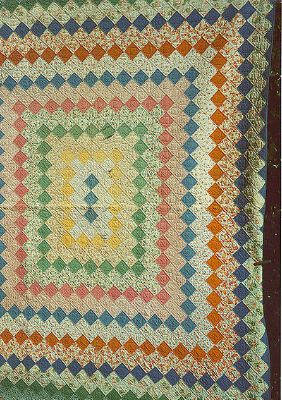
One of a pair for twin beds. Frame quilt entirely in rectangles of squares radiating from small central rectangle. Alternating rows of plain and patterned cottons. All squares are on edge. Padding is cotton and backing is plain white muslin. 2220 x 1540 mm.
History:
The maker is unknown but it is thought the quilts were made in Arkansas USA. They were owned by Mr. and Mrs. Homer DeFriest and now by their daughter-in-law. Both quilts are still used and each is kept at the foot of the twin bed in the owner's home.
Story:
The quilts were given to the present owner and her husband in 1955 and went with them to the various countries in which James Ellis DeFriest worked: Kenya, Sierra Leone, New Zealand, Ghana and Australia.
Related Quilts:
Hexagon quilt made by hand from a wide variety of cotton materials. There is no padding and the backing is calico.
2286 x 915mm
2286 x 915mm
Pieced quilt featuring log cabin and tumbling block patterns. It is handsewn and has some appliqued flowers.Materials are mainly velvet with a small amount of cotton. There is no padding and the backing is cotton flannelette.
1525 x 1220mm
1525 x 1220mm
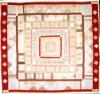
"A medallion or framed quilt in design. There is a central field of small patchwork diamonds, and from this radiates plain stripes of fabric bordering areas of patchwork panels. The edge of the quilt carries bands of red cotton, which are slightly larger at the top and bottom edges, and here the band is additionally decorated with appliqué diamonds. The fabric of the patchwork is cotton in fine plain weave of pale coloured florals and small geometric designs. The framing and border stripes are of bright red twill weave cotton. The small diamonds of the central field are hand sewn, with more use of machine stitching around the outer edge of the quilt.
The quilt is not padded. The patchwork is fully lined with a printed plain weave cotton fabric with a design commemorating Queen Victoria's Jubilee. The design is based on a repeated grid of circles. In the centre of each circle is a cameo of Queen Victoria, surrounded by images of the national flowers of England, Scotland and Ireland: the rose, the thistle and the shamrock. The edge of the front face of the quilt is trimmed with a red and white cotton braid." [NGA] 2380 x 2220mm
The quilt is not padded. The patchwork is fully lined with a printed plain weave cotton fabric with a design commemorating Queen Victoria's Jubilee. The design is based on a repeated grid of circles. In the centre of each circle is a cameo of Queen Victoria, surrounded by images of the national flowers of England, Scotland and Ireland: the rose, the thistle and the shamrock. The edge of the front face of the quilt is trimmed with a red and white cotton braid." [NGA] 2380 x 2220mm
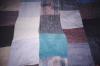
Double sided patchwork quilt/rug constructed from squares machined together in strips and then the strips joined. It is made in one piece and then doubled over. The materials are mainly wool, worsted, part cream machine made jumper, pink and blue mohair, blue and white spotted flannelette and cream blanket and all are scraps or from worn clothing.
1690 x 1370mm
1690 x 1370mm
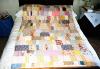
Patchwork quilt of square and rectangular patches, mainly in cotton fabrics, in plains and prints. Colours are predominantly yellow, pinks, blues and prints on white. Backing is the same except there is a piece of patterned curtaining material as a patch across the middle width. Padding is old blanketing.
1830 x 1140mm
1830 x 1140mm
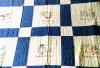
Patchwork quilt made for a child. All cotton with cotton padding. White blocks have embroidery depicting different nursery rhymes eg Mary, Mary, Quite Contrary ; Old Mother Goose. These blocks are separated by rectangular strips of teal cotton. The quilt is hand stitched and heavily quilted.
1677 x 1271mm
1677 x 1271mm