
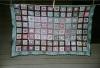
Quilt No.339JE - Joanne Evers
2100 x 1400mm
Made in 1960 by Dorothy Evers at Maroubra (NSW). Previously owned by Dorothy, now owned by her daughter Joanne Evers.
"During WWI there was an influenza epidemic. My two sisters were ill and confined to bed. (Masks had to be worn by the public). I was not allowed near them but mother gave them a task to do, sewing little circles of white cotton material into little 'mob caps'. 12 each per day, and they called them '12 apostles'. I learned how to make them too. Later they were sewn together and made into pillow shams.
The depression started around 1929, I met my husband to be and we became engaged, then firms closed, jobs were lost, and Tom Evers' place of work closed - he was a tailor's cutter. The next 4 years were heartbreaking, any sort of job was tried, nothing was permanent, suits were the last thing to be acquired. Finally he got the job of cutting in a manufacturing Tailors, and if he could hold that for one year we would marry.
Meantime, I was sewing little 'mob caps' in coloured and printed materials, cotton and rayon mostly, materials were scarce and expensive but there were lots of little left over bits from dressmaking and many pieces were given to me, as a result we had 2 lovely Quilts that covered 3/4 beds right over. I used black sateen to line them. Tom said 'they are round circles, yet they look square' and called them 'squirkles' a name that is very descriptive, and is still used today by me and many others.
Those first quilts lasted nearly 20 years, faded a lot and some squirkles fell to pieces so I discarded them.
Since then I have made new quilts every now and then, at times rayon rotted, so cotton is my favourite material. I have used good, firm material to back them, once dark green, another bright navy; once fawn, but that was very disappointing, the dark backing brought out the colours.
I made one about 1964 which I gave to Joanne, my daughter in law and she is still using it in 1998.
� altogether I've made 12 quilts for 3/4 beds, 1 Knee rug, 5 cot covers and about 4 cushions since 1929, and whenever I see a small piece of suitable material around I can still make a squirkle 'just in case'. I think I always shall as I still make my own dresses."
[letter from Dorothy Evers, 1998.]
Related Quilts:
No padding. Backing is red cotton, embroidered 'M.A. Wilson 1863'. Handsewn.
2500 x 2170mm
Hand sewn and hand quilted.
2236 x 1804mm
2236 x 1550mm
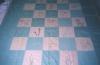
2350 x 1530mm
1770 x 1380mm