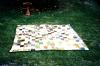
Quilt No.38SM - Regina Murphy

Regina Murphy
Owner: 
Regina Murphy
Location: 
WA Perth
Maker
Maker: 
Regina Murphy
Made in
AUSTRALIA WA
Date: 
1941 - 1970
Description: 
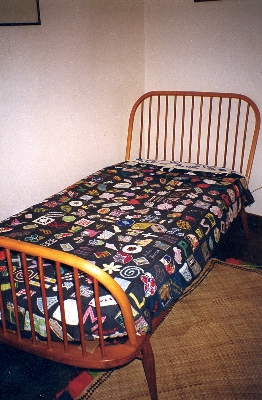
Denim squares approx 9cm (square) machined together and handstitched to backing sheet. Each square is appliqued individually using natural and synthetic (few) materials. Applique both machined and hand stitched. Backing is unbleached calico.
2280 x 1310mm
History: 

Quilt was made by Regina Murphy for her daughter Sarah between 1964, when her daughter was born, and her first birthday in 1965. Later squares were added to each side. The quilt is owned by Sarah Murphy WA.

Story: 

"Sarah's Quilt
My first child Sarah Therese Murphy was born on 10.3.64. It was the 'Hippie Era' a period of flower power motifs and a preponderance of denim fabrics. I had been brought up in Kalgoorlie WA. My own bed was covered with a white 'Marseilles' quilt, & the frilled pillows with a beautifully embroidered pillow sham. My sister and I were forbidden to even sit on our beds - they were only for sleeping - & then only when the quilt and sham were carefully folded and placed over a wooden towel stand.
My greatest pleasure was to visit my friend in the next street, who lived in a very different household. She had a patchwork quilt, not a work of art to be admired, but a colourful, casual cover to enjoy & even to snuggle under on cold winter days. We would lounge on Gail's bed & read books or talk for hours. After my daughter was born I decided I wanted to create that type of ambience for her bedroom. Her bed was an English Ercol, Windsor style made of beech, curved at head & base. This meant that a conventional quilt would not sit as easily as one created to custom fit. What could suit my aim better than the popular denim. I commenced by cutting 4" squares from every unworn garment I could find. Each square was then decorated with applique or embroidery or both. I started with a 'baby' embroidered motif from a greeting card she had received. The quilt includes pieces from hair ribbons, favourite dresses, pieces of lace from her christening dress, & embroidery. The centre was completed for her first birthday when she moved into her own bedroom.
Each 4" square was turned and stitch by machine for strength. The squares were then joined together & finally attached to an unbleached calico sheet. This meant that the quilt could be used & the calico tucked into the matress. Later as Sarah's interests grew squares were added to each side to cover the sheet. The base is curved to cover the contours of the oval matress. It is a folksy quilt which I hope, achieved its original objective.
Sarah is now married & both bed & quilt reside in the 'spare room' of her own home." [Regina Murphy 20.4.97]
"The squares also tell stories - initials of each family member, names of dogs & cats, symbols of Ireland (family homeland), universities attended and pieces of Sarah's wedding clothes. It tells a number of stories & provides many memories." [RM]

Related Quilts:
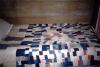
Muriel Hartmann
Reused parts of hand knitted woollen jumpers patched together. Wide crocheted edge from wool unravelled from jumpers retrieved from the tip.
1905 x 1525mm
N.S.W. Parks and Wildlife Service
Double sided quilt. Side 1 has an off centre frame based on a hexagon and including triangles and squares in a concentric pattern. The borders are all small rectangles with a single strip of large rectangles at one end. Side 2 has a central patch of pieced shapes appliqued to the background. The borders are squares and rectangles many in striped shirting cotton. Side 1 has minimal quilting to the interlining but it does not go through to side 2. The padding is a thin sheet.
The circle (sometimes pieced hexagons) is common to other 'Craigmoor' quilts.

1450 x 1230mm
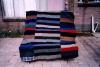
National Gallery of Australia
" Reversible patchwork quilt of woollen suiting in grey, blue, navy, maroon and brown. The fabrics appear to be new tailor's sample pieces (the sizing is still present on the fabric, signifying it has never been washed). The patches are rectangular and vary in size. Both sides have different designs. The front of the quilt has 4 rows of 12 vertical rectangles then below this are 4 rows of 7 horizontal rectangles followed below by 4 rows of 11 vertical rectangles. The reverse of the quilt has a section at the top and bottom composed of 5 rows of 9 horizontal rectangles. The central area is made up of a centre section of 6 rows of 5 vertical rectangles; flanked on either side by a column of 10 horizontal rectangles and two columns of 8 smaller vertical rectangles.
The patchwork layers are joined at the edges with machine stitching. The patchwork layers and padding are machine quilted on the front down 2 vertical lines following joins in the patchwork; therefore not being totally straight. The lines are more noticeable on the reverse as the 2 sides do not match. The front face is displayed at the NGA.
Between the patchwork layers is a striped cotton blanket in black, sky blue, white and cream." [NGA]
2082 x 1386mm
The Pioneer Women's Hut
Machine constructed log cabin quilt using a wide variety of strips of used clothing including cottons, men's suitings and wools. Each square is about 250mm and arranged in the 'light and dark of the fire' variation of log cabin. There is no padding. The backing is brown twill with an orange pattern and is probably a replacement backing.
2180 x 1710mm
June Brown
This quilt has been strip pieced with no regular pattern. It seems a large quilt has been made then folded in half. The materials used are woollen skirting pieces in a variety of colours. It could be used either way. There is no padding and it is very heavy.
2100 x 1950mm
Julie Bos
Crazy patchwork quilt with pieces made from cottons, rayons, silks and taffetas. Each piece is stuffed with kapok and machine sewn to a backing then a wholecloth floral cotton backing has been added.
920 x 164o mms