
Quilt No.930ESA - The Embroiderers' Guild of S.A.Inc Museum
Owner:
The Embroiderers' Guild of S.A.Inc Museum
Location:
SA Adelaide
Maker
Maker:
Ida Summers
Made in
AUSTRALIA SA
Date:
1921 - 1940
Description:
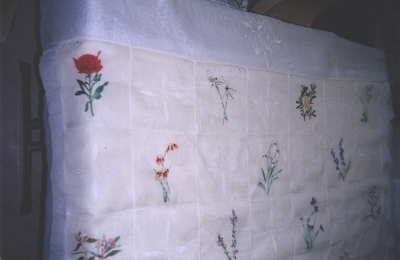
Wholecloth quilt in white cotton voile with alternating designs of Australian wildflowers worked in multi coloured cottons and shadow work. It is backed with yellow voile. There is no padding.
2010 x 1910mm
2010 x 1910mm
History:
This Adelaide Chronicle wildflower quilt was made by Miss Ida Summers in South Australia c.1933. It was later owned by Mrs. Jennifer Alde and is now in the collection of The Embroiderers' Guild of SA Inc. Museum.
Story:
"Miss Ida Summers worked for Jean Mattic of Terowie S.A. in the 1930s on a sheep station. Among her duties she helped the children with their correspondence lessons. During the war she joined the Air Force. She learnt painting/pencil and wash from Ruth Tuck."
[The Curator, Embroiderers' Guild of SA Inc. 19/1/99]
Related Quilts:
Unfinished cotton frame quilt. The centre square is 4 triangles and this is surrounded by a border of smaller triangles. Most of the other borders are of triangles in a wide variety of materials, printed and plain.
2286 x 1829mm
2286 x 1829mm
The top is machine pieced patches of used clothing. The backing is large pieces of dress materials and either end patches similar to the top. The padding is a chaff bag or similar with patches of worn, matted children's jumpers sewn directly on to it.
1400 x 1150mm
1400 x 1150mm
Patchwork quilt of cotton hexagon patches grouped in 'flowers', comprising 4 rings of patches around a central hexagon. Prints and plains are used, the colours mainly browns, greens, yellows, dark blue and dark pink. The 'paths' are in a yellow-brown cotton. Cotton backing. The padding is probably an old blanket. The quilt is an irregular shape, and is tied.
2550 x 1870mm
2550 x 1870mm

Hand stitched silk quilt in mosaic patchwork based on triangles. Pieces include dress materials and some embroidered linings fom men's waist coats. Paper templates. The backing is cotton.
2200 x 2000mm
2200 x 2000mm

The centre of the quilt is a small blue 6 pointed star surrounded by a larger blue star. Blue stars also form a border to the quilt. The background material is a multicoloured small floral pattern on white cotton. The quilt is all hand worked over templates. The padding is cotton and the backing is polyester sheeting with a border of stars.
2650 x 2475 mm
2650 x 2475 mm
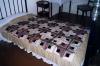
Patchwork quilt in Log Cabin pattern made from silks, velvet, cottons and taffetas, in prints and plain, around a centre squares of black velvet. Colours are, in the dark sections, blues, greens, browns, yellow and pinks. The base of the blocks is blue and white ticking. The padding is probably cotton. Backing is of green cotton. There is an attached frill on all sides of green cotton, faded to dull light brown.
1630 x 1350mm
1630 x 1350mm