Quilt No.989TL - Thelma Lithgow

Thelma Lithgow
Owner: 
Thelma Lithgow
Location: 
SA
Maker
Maker: 
Margaret Clucas
Made in
SHIPBOARD England
Date: 
1881 - 1900
Description: 
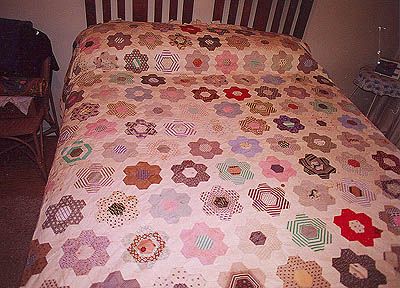
Repeat block quilt top based on hexagons, each 350 mm diameter. Six hexagons and a centre one make a 'flower' and these are set in rows against a plain calico background. Patterned cotton fabrics are used for the hexagons, small prints, fine stripes and tiny flowers. As it is a quilt top only, there is no lining or padding. 2100 x 1800 mm
History: 

The quilt top was made by Margaret Clucas in 1882 on the ship 'Potosi' travelling from the Isle of Man to Australia. It was then owned by her daughter, Mona Harvey (born Clucas) and then her grand-daughter Thelma Muriel Mona Lithgow born 1909.

Story: 

"Margaret Clucas nee Lewin, born Isle of Man 1834, married John Clucas and migrated to Australia via England, travelling on the cargo passenger ship the 'Potosi' 1882. While travelling on the 'Potosi' Margaret made the quilt top but it was never backed. John and Margaret Clucas were both school teachers and were quickly registered in their profession on arrival in St. Australia, Constantly moving around in difficult conditions occupied all their spare time. Hence the quilt was never completed. The hexagon papers were old letters but they have disintegrated over time." [Yvonne Daniel]
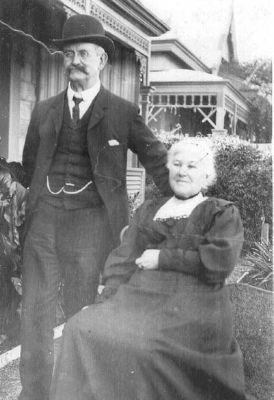
John and Margaret Clucas

Related Quilts:

National Gallery of Australia
"The Rajah "quilt" is a patchwork and appliquéd bed cover or coverlet. It is in pieced medallion or framed style: a popular design style for quilts in the British Isles in the mid 1800's. There is a central field of white cotton decorated with appliquéd (in broderie perse) chintz birds and floral motifs. This central field is framed by 12 bands or strips of patchwork printed cotton. The quilt is finished at the outer edge by white cotton decorated with appliquéd daisies on three sides and inscription in cross stitch surrounded by floral chintz attached with broderie perse on the fourth side. All fabrics used in the Rajah quilt are cotton with the exception of small amounts of linen and silk threads. The quilt shows evidence of being produced by many hands." [NGA] The quilt is not padded or lined. 3372 x 3250mm
Fran Williams
Quilt with centre area of silk triangles framed with small squares and the rest of the top is larger squares. Wide variety of prints and plain materials. There is no padding. The backing is cotton and "E.M.B." is cross stitched in one corner. "Back is interesting as it's all the same fabric, joined but it appears to have been stitched with a running stitch (cf quilting) before it was attached to the front. It was definitely done after being joined as the stitching design follows through the seams." [Fran Williams]
2500 x 2500mm
Mare Carter
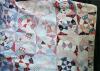
Patchwork cradle quilt of pieced repeat blocks. All cotton including cotton filling. Pattern is in faded greens and pinks,"4 pointed star" in circles. There are 20 blocks.
991 x 788mm
Glenda Wilkinson
Small quilt made from pieces of heavy weight wooollen coat material cut into strips and machined together. It is reversible. Each side is made from different materials but in similar colours of aqua, blue, green and beige. The 2 layers are quilted together with a few machined lines of straight stitching. It has a folded and machine stitched edge. There is no padding.
950 x 790mm
Val Ireland
The top of this utility quilt is machine pieced rectangles of woollen materials joined in strips. It includes corduroys and velveteens and woollen tartan. The backing is an Indian cotton blanket.
1651 x 1271mm
Jindera Pioneer Museum
Quilt made of 26 x 13 rectangles of woollen men's suiting samples. Each rectangle is about 70 x 130 mm. Wide variety of patterns, mainly stripes, and colous. The padding is part of a worn cream blanket and joined pieces of woollen clothing. The backing is a well worn piece of brushed cotton. Machine made.
11900 x 1870 mm