
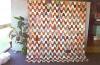
Quilt No.112MH - Muriel Hartmann
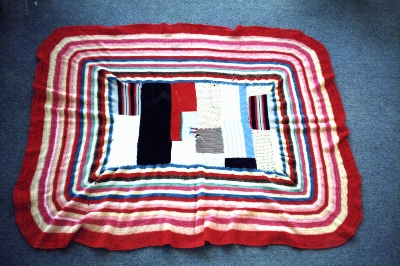
1905 x 1525mm
Made by Elsie Hartmann , 1910-1996, at Blackall Queensland. It is typical of many she made for warmth and of necessity. Now owned by her daughter-in-law Muriel Hartmann.
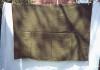
"With the wool pack Wagga I may not have used two side pieces. One piece formed the top and side and the other piece side and bottom. The two pieces stitched together and the ends bound with coloured material to stop the ends unraveling. I think that's how it went. We could not afford to buy blankets. At the time my husband worked for a sheep farmer in northern N.S.W and we had 3 small children and it got very cold in the winter then. The frost hung in icicles off the fences and off the cows noses, the wind was very cold blowing through the house. I used wheat bags opened up under the mattress with newspaper to keep the cold air from coming up and the Waggas on top. Some of the old army blankets I used for Waggas belonged to my great uncle Ben Stephens who had come out to Australia as a teenager from England. He worked on properties , living in old huts, fencing and so forth.
My mother in law could not afford new blankets and was a very thrifty person and made do with what she could and made the rugs out of old jumpers cut up and crocheted around with wool unpicked from other old jumpers. Some she had picked up from the town dump. Some were jumpers she had knitted for her grand children and had shrunk as well as growing out of them. I had given them back to her for the rugs. I think the last one she made and the one I have were made about 1975. She had made Waggas with bags and blankets too.
My Mother did too as during the war and with coupon rationing she had to make do with what she could. She made all our underclothes from white flour bags boiled up to get the name off the bags. Mum made all her own bread so she had plenty of bags.
My great aunty Adelaide did too and made us children strip corn husks to make mattresses. They made plenty of noise when one turned over on them. The old saying hard work never killed anyone as my aunt lived well into her nineties, nearly made 100 and so did her sister. They lived on the land working dairy farms through two world wars and the depression.
P.S. I did not use the Wagga to cover up plants from the frost this winter, have packed it away."
[Muriel Hartmann 1997]
Related Quilts:
1800 x 1940mm

1956 x 1702mm
1524 x 1372mm
1620 x 1180mm