
Quilt No.805QVM - Queen Victoria Museum and Art Gallery
Description:
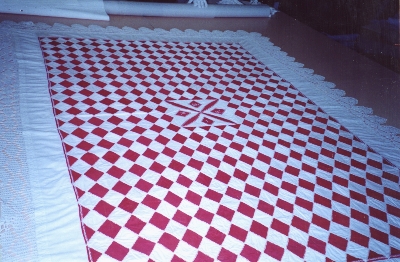
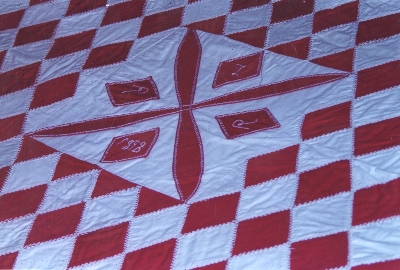
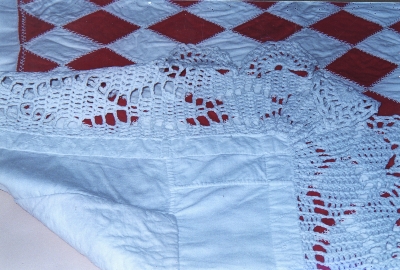
Quilt with alternate red and white diamonds in cotton, with wide border of white cotton and a white cotton crochet edging. All diamond patches and edging were joined to white border decorated with feather stitch. White border edged with zig-zag white feather stitch. Centre rectangle of white has 4 red petals edged with white feather stitch and 4 red diamonds each embroidered in white clockwise: '1898', 'R', 'L', 'K'. Diamonds edged with feather stitch. There is no padding and the backing is white cotton.
2420 x 1740mm
2420 x 1740mm
History:
The quilt was made in Tasmania by Rachel Louisa Raspin (1863-1932) c.1898. It was given as a gift to Clarice B. Raspin by Mrs. Miriam Raspin whose husband George was Rachel's brother. It was donated to the Queen Victoria Museum and Art Gallery in 1994 by Mrs. Clarice Raspin.
Story:
Rachel Raspin, the maker, was born at Prosser Plains, east coast of Tasmania near Buckland on 24th. December 1863. She passed away at Buckland where she lived most of her life, on 3rd September 1932. She was the seventh of twelve children born to Thomas and Sarah Raspin of Prosser Plains. Rachel Louisa never married.
Related Quilts:
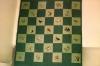
Patchwork quilt made from alternate squares of light green and medium green cotton headcloth. The light green squares are hand embroidered with Australian native birds, the medium green squares are decorated with pulled thread designs. No padding. Backing and binding of medium green headcloth. Made from patterns published in The Adelaide Chronicle.
2650 x 1573mm
2650 x 1573mm
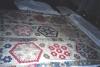
Patchwork quilt in Grandmother's Flower Garden pattern consisting of groups of 7 rosettes and single rosettes with white filler hexagons and a border of rosettes alternating with 'bow tie' shapes of 5 patches in the middle of the quilt. Hand sewn in cotton dress and shirting materials , the colours mostly blues, pinks, reds, brown and white. The quilt top is covered in netting. There is no padding and the backing is cream cotton twill.
2270 x 2080mm
2270 x 2080mm
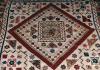
Unlined quilt. Central square of floral chintz with rectangular and chevron border making a larger frame that is set within another square-on-point frame edged with 2 toned red leaf pattererned chintz. This quilt is mainly pieced (squares, triangles, lozenges) but the hexagon rosettes are appliqued. Dress and furnishing cottons dating from the early 1800s. Raw edged, unfinished. All hand stitched.
2400 x 2400mm
2400 x 2400mm
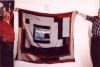
Double sided frame quilt. All reused materials including corduroys, wools and light weight suitings. Machine made and not quilted There is no padding as already heavy and warm.
1780 x 1530mm
1780 x 1530mm
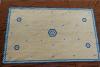
Patchwork quilt made of 1 inch hand paper pieced hexagonal patches (English technique), with plain and floral patterned blue fabrics in clusters at regular intervals throughout the taupe coloured patches. Centre of quilt has a cluster or 'flower' of 4 rings of patches, the centre group embroidered in blue satin stitch: 'MW 1938'. Border consists of 3 rows of medium, light and dark blue hexagons. No padding. Backing is of blue cotton sateen.
2185 x 1372mm
2185 x 1372mm
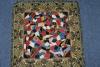
Crazy patchwork quilt made from silk, brocade and velvet pieces, the seams covered with feather stitching in yellow silk. Fabrics are plain, and patterned with tartans, woven spots, stripes and floral brocade. Colours are rich, mainly red, pink, blue, green and cream. Quilt has a patterned velvet or velour border with urns and flowers in pale olive green and black, edged with a fringe in these colours.
1090 x 1040mm
1090 x 1040mm