Quilt No.17DMS - Dubbo Museum & Historical Society Inc
Dubbo Museum & Historical Society Inc
Owner: 
Dubbo Museum & Historical Society Inc
Location: 
NSW Central West
Maker
Maker: 
Susannah Gibbs
Made in
ENGLAND
Date: 
1851 - 1880
Description: 
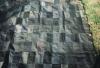
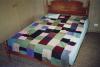
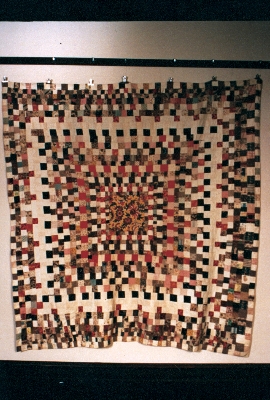
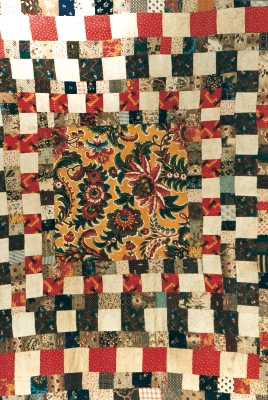
Frame quilt with central square of floral patterned chintz with a yellow background, surrounded by borders of squares and rectangular pieced fabrics, dark pieces mostly alternating with light. It is hand pieced and flat quilted.
History: 

Owned by Susannah Gibbs (1828 -1896) who married Obadiah Hoath and came to Australia in 1856. Their daughter Hannah Maria Hoath (1861 - 1945) gave the quilt to her granddaughter Irene Kilfoyle, who donated the quilt to Dubbo Museum in 1983.

Story: 

Susannah Gibbs (1828 - 1896) and Obadiah Hoath (1830 - 1878) were married in England and came to Australia in 1856. The quilt came with Susannah. It was stored in a wooden trunk which got wet on the voyage and the quilt still has some water marks from this.
Susannah and Obadiah went to Daylesford and lived there all their lives. Obadiah was a bricklayer. One of their children was Hannah Maria (1861 - 1945) who married Hugh Griffith in 1893. Hannah was a dressmaker. They lived in Victoria until 1912 when they came to Eumungerie (small town near Dubbo) where land was opened up and they had a block until about 1927 when they came into Dubbo.
Hannah was Irene Kilfoyle's grandmother and gave her the quilt. Irene gave the quilt to Dubbo Museum in 1983, together with other items that had belonged to her great grandmother Susannah.

Related Quilts:
Harden Murrumburrah Historical Society
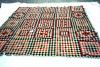
Patchwork quilt has pieced blocks in the 'Ohio star' pattern in red print and white cotton, alternating with plain white blocks. Quilt has a 9cm frill in red and grey geometric print cotton, machine stitched around the edge. Quilt appears to have some hand quilting. No padding. Backing is white cotton.
2210 x 2060mm
The Pioneer Women's Hut
Machine pieced crazy patchwork quilt in plain, floral and striped cotton materials. Some pieces are seamed and others are sewn direct on to calico backing. Each piece is outlined in red stranded cotton in herringbone stitch.
2150 x 1770mm
Powerhouse Museum
"A tied patchwork wagga quilt made from swatches of men's wool suiting fabrics in blue/grey and pink/brown tonings. Rectangular swatches have been cut in half diagonally, and the resulting right-angled triangles paired to form larger equilateral triangles which alternate dark with light across the field. The quilt has been machine and hand pieced, then machined in vertical stripes.
The centre field is bounded by two strip-pieced borders at top and bottom, and three down each side. These are sewn from rectangles, using light pink/brown tones for the inner border and darker colours for the outer borders. The quilt is padded and backed and the side seams are secured with black herringbone stitch. The three layers are tied together invisibly with lazy daisy stitches in black cotton from the back." [PHM] The padding is a wool blanket and the backing is two pieces of cream twill cotton.
2030 x 1440mm
Annette Gero
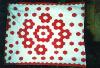
This quilt is of hand pieced hexagons randomly placed and stitched on to a linen backing. They are mainly dress fabrics and chintz with some hexagon flowers in the centre and corners in broderie perse. There is no padding.
2600 x 2600mm
Mrs. L. M. Chick
Hexagon quilt made by hand from a wide variety of cotton materials. There is no padding and the backing is calico.
2286 x 915mm
National Gallery of Australia
"A medallion or framed quilt in design. There is a central field of small patchwork diamonds, and from this radiates plain stripes of fabric bordering areas of patchwork panels. The edge of the quilt carries bands of red cotton, which are slightly larger at the top and bottom edges, and here the band is additionally decorated with appliqué diamonds. The fabric of the patchwork is cotton in fine plain weave of pale coloured florals and small geometric designs. The framing and border stripes are of bright red twill weave cotton. The small diamonds of the central field are hand sewn, with more use of machine stitching around the outer edge of the quilt.
The quilt is not padded. The patchwork is fully lined with a printed plain weave cotton fabric with a design commemorating Queen Victoria's Jubilee. The design is based on a repeated grid of circles. In the centre of each circle is a cameo of Queen Victoria, surrounded by images of the national flowers of England, Scotland and Ireland: the rose, the thistle and the shamrock. The edge of the front face of the quilt is trimmed with a red and white cotton braid." [NGA] 2380 x 2220mm