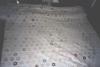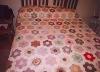
Quilt No.249HS - Helen Sparkman

Helen Sparkman
Owner: 
Helen Sparkman
Location: 
SA Adelaide
Maker
Maker: 
Matilda Pitt
Made in
AUSTRALIA SA
Date: 
1921 - 1940
Description: 
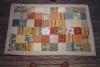
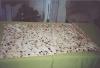
Patchwork quilt made from very large pieces of cotton material on one side, with a 100mm yellow border, and on the other side it is almost entirely blue flannelette.
1660 x 1400mm
History: 

This functional quilt was made by Matilda Pitt (born Bowman) (1860-1953) who was the great grandmother of the present owner. It is thought to have been made about 1920 and has always been owned by members of the Pitt family. It is not used now.

Story: 

"Matilda made these 3 quilts, probably in the early 1920s. Henry and Matilda Pitt and family lived at Stansbury S.A. until 1920 when they moved to a property at Balhannah S.A. The very cold winter in the Adelaide Hills created a need for extra night warmth, and so Matilda made 'rugs' for the family members, which by this time included grand children�����.As the description suggests , these quilts were quite heavy. The kitchen table provided an ideal work surface for these projects. These quilts represented very practical recycling, in an era when there was very little waste - even in the situation where there was no real need for thrift in this family. Matilda made quite a few quilts - the family members are fortunate to still have three of them."
[Helen Sparkman Dec. 2000]
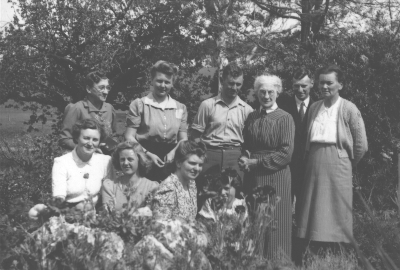
Matilda Pitt (3rd from right) and family members 1946

Related Quilts:

National Gallery of Australia
"The quilt consists of 12 blocks of crazy patchwork with an embroidered border. The quilt is made of 167 different fabrics; most of these are silk. These velvets, printed silks and satins are beautifully embroidered with flowers, household items and Kate Greenway images of children at play. Many of the motifs have a strong influence from the Aesthetic Movement. The edge of the quilt carries a border in maroon silk decorated with tendrils and daisies in very fine embroidery.
The patches are joined with hand sewing and embroidery, however the 12 panels are joined with machine stitching (chainstitch machine stitching). The blue silk lining was hand sewn into position with silk thread." [NGA]
"The quilt does consist of three layers but the central layer is not padding. The crazy patch pieces were sewn together and this was lined with white cotton fabric prior to the embroidery at the edges of the 12 panels being placed. This in turn was lined with a fine blue silk." [NGA] 1810 x 1460 mm
Annette Gero,
Wholecloth quilt originally covered with cretonne and recovered with orange satin. Machine quilted. Padding of wool.
1270 x 1160mm
National Trust of Australia (SA)
Randomly patched quilt in many different colours and fabrics. There are appliquéd shapes over many pieces including Suffolk Puffs, hearts, hexagons and other shapes. There is an embroidered inscription "A11 to S11 1829" which is thought to mean AN to SN 1829. There is no padding and the backing is white cotton.
2000 x 2200mm
Annette Gero
Quilt top of hexagons in silks and satins, pieced over papers in the English tradition. Some paper templates still in place. One states: 'Semi - Monthly Regular Clipper packets to New Zealand, Port Phillip, Sydney�2nd of each month..Adelaide' suggesting it may have been from a shipping timetable.
1580 x 1830mm
Mildura and District Historical Society
Quilt of 2025 hexagons stitched together to form diamond patterns. Hand sewn using paper templates. Materials are cottons and plains typical of the thirties period. The backing is blue cotton and the quilt is bound with many rows of coloured bias binding through which is treaded window cord. There is no padding. The quilt is called 'Grandmothers' Flower Garden quilt'.
2439 x 1829mm
Shirley Maywald
Patchwork crazy quilt in velvets and silks, no pieces over 4" long. Colours are black, maroon, pinks, blues and pastels, and all seams embroidered with coloured silks in herringbone stitch. Backing is green, there is no padding. Quilt is bound with black velvet 1/2" wide. A patch near the centre is embroidered: '1909' and '1948'.
940 x 915mm