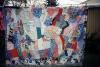
Quilt No.1007PH - Pearl Holland

Pearl Holland
Owner: 
Pearl Holland
Location: 
QLD South East
Maker
Maker: 
Pearl Holland
Made in
AUSTRALIA VIC
Date: 
1941 - 1970
Description: 
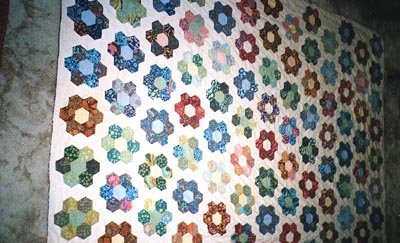
This is one of two single bed quilts in a pattern the owner calls 'Martha Washington's Flower Garden'. Flowers are in six hexagons in a variety of prints with a plain coloured centre. The background is cream, and the backing is calico. 2500 x 1800 mm.
History: 

This quilt was made by Pearl Holland in approximately 1956 in Castlemaine, Victoria. It is still owned by Pearl Holland, and is used in the family holiday unit in Hervey Bay, Queensland.

Story: 

"The name (Martha Washington's Flower Garden) was given to Pearl by Mrs Brent Clarke who was President of Quilters Association in Melbourne at one stage. In the 1920's, Pearl had seen her mother's friend working on a quilt with this pattern, so these quilts are from her own memory of what she saw then. She used sample materials from Sekers Wholesalers in Melbourne who gave her the pieces still in their bundles after she was introduced with a letter from a local Castlemaine draper (Max Rigg)."
"Pearl Holland (nee Chanter) was born at Numorkah in N.E. Victoria in 1910. She has always been interested in craft work and has tried many forms including weaving, leatherwork, copper and enamelwork, quilting, tatting, crochet work (hairpin crochet using fine wool from Castlemaine Woollen Mill - blankets were made from this), cane goods, knitting, wood carving, macrame, china painting and many forms of embroidery. She was a member of the Victorian Embroiderer's Guild and presented workshops around the Midlands area during 1960's and 1970's. Samples of her copper and enamel work are on display under the banner of the Stanley Ellis School at Castlemaine Art Gallery. After retiring to Queensland with her husband in late 1970's, Pearl has continued her craft work interests and at age 91 (Sept 2001) still creates creditable work. A present project is a colourful knee rug for her daughter in law." [Pearl Holland]
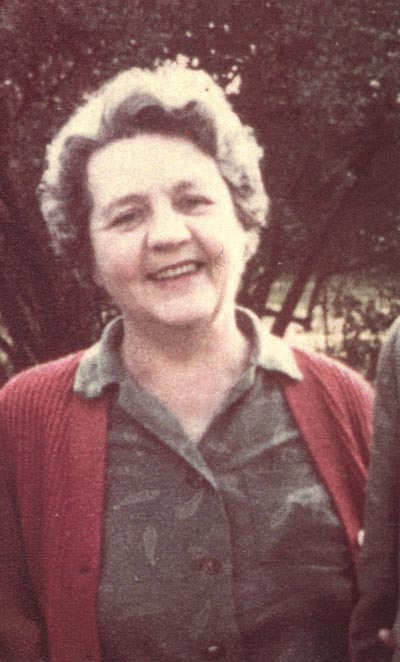
Pearl Holland c.1956
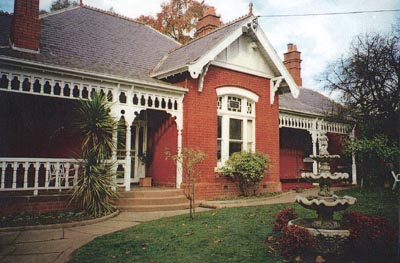
Holland family home (house built 1893) where quilt was made. Castlemaine, Victoria

Related Quilts:

Lyn Cottingham
Single bed quilt hand pieced from silk hexagons using the English method. The border, backing and central rosette of hexagons are black. All other hexagons are a mixture of plain colours, stripes and florals. They are randomly placed. It is quilted in a diamond pattern. The padding is a thin cotton woven material.
1550 x 1330mm
Harden Murrumburrah Historical Society
Patchwork quilt has pieced blocks in the 'Ohio star' pattern in red print and white cotton, alternating with plain white blocks. Quilt has a 9cm frill in red and grey geometric print cotton, machine stitched around the edge. Quilt appears to have some hand quilting. No padding. Backing is white cotton.
2210 x 2060mm
Yass & District Historical Society
Patchwork quilt made from diamond patches in the 'Cotton Box' pattern, in a wide variety of cotton fabrics, including plains, checks, stripes and florals. The patches have blotting paper templates. The quilt is edged with diamond shapes in a red floral cotton. The backing is of the same red floral pattern, featuring yellow, turquoise and white flowers and leaves. Hand sewn.
2135 x 2033mm
Ankie King
Small square piece of crazy patchwork in silks and taffetas. Many of the seams are oversewn with decorative embroidery stitches. There is a calico backing.
550 x 550mm
Glenda Wilkinson
Small quilt made from pieces of heavy weight wooollen coat material cut into strips and machined together. It is reversible. Each side is made from different materials but in similar colours of aqua, blue, green and beige. The 2 layers are quilted together with a few machined lines of straight stitching. It has a folded and machine stitched edge. There is no padding.
950 x 790mm
Dubbo Museum & Historical Society Inc
"English patchwork pieces. 1110mm x 1500mm. Hand pieced by at least two people. Made from scraps, cut down clothing and sheeting. Backing made from shirtings, dress fabrics, furnishing fabric and ticking. No synthetics. Machine quilted. Condition, fragile�.." [Dubbo Museum]