Quilt No.862AG - Annette Gero

Annette Gero
Owner: 
Annette Gero
Location: 
NSW Sydney
Maker
Maker: 
Gil Jackson
Made in
AUSTRALIA NSW
Date: 
1921 - 1940
Description: 
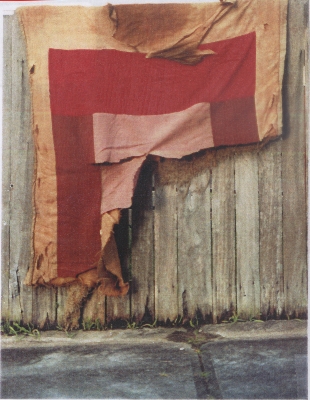
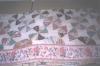
Domestic Wagga made from wheat bags sewn together and covered with large pieces of material.
1400 x 1230mm
History: 

This domestic Wagga rug was made by Gil Jackson (1906-1995) in the Nowra district NSW c.1926. It is now in the collection of Annette Gero.

Story: 

"Gil was the second eldest son of a family of four sons from Gloucestershire. He always had a hankering to see more of the World. Read about the 'Dreadnought Scheme' and applied for assisted passage. When first arriving in Australia in 1925, Gil, like every 'boy' who came out from England with the 'Dreadnought Scheme' was sent to Scheyville Farm up the north coast and trained in farming.
After three months at Scheyville, Gil was sent to Nowra, to Murphy's farm, at Lower Nimba. This is where he made the 'Wagga' quilt. He certainly didn't have many possessions at this stage. 'Murphys' was a happy place, a big family of three boys and three girls.
After three years in Nowra, wishing to better himself, he moved to Sydney. He had a rough time getting permanent work, tried all sorts, when things got really tough with the depression, he 'humped his bluey' and took to the road.
During his stay in Sydney he stayed in many cheap boarding houses. He met his first wife during this time. The woollen fabric may have been her shirt and there is also a small child's dress covering the original hessian bags. The wagga must have been special to him as he kept it till his death in 1995." [Annette Gero]

Related Quilts:
West Tamar Historical Committee
Wholecloth quilt with both sides of floral cotton. The padding is thought to be hessian bags.
2060 x 1300mm
Jeanette Marchant
Quilt of hand stitched cotton hexagon patches, the hexagons are in groups of 7 to form flowers, with white or cream 'paths'. The quilt centre has 19 flowers grouped within a single hexagon border of brown and red patches. In each corner of the quilt there are 6 flowers grouped around a larger flower within a single border of darker print hexagon patches. Backing is cream cotton, machine stitched to the top. There is no padding or quilting. Some fabric patches have deteriorated.
National Gallery of Australia
" Reversible patchwork quilt of woollen suiting/upholstery fabrics in khaki, greys, blues and browns. Both sides have different designs. The front of the quilt has 13 rows of 12 vertical rectangles flanked on either side by a column of 22 horizontal rectangles. The reverse has a more interesting and complex design of small and very large rectangles, squares and triangles; with khaki contrasting with the duller greys and blues. The patchwork layers are joined at the edges with machine stitching and the quilt is machine quilted along 3 horizontal lines following joins in the patchwork; therefore not being totally straight. These lines are more noticeable on the reverse. The reverse face has been on display at the NGA." [NGA] There is a cotton blanket used as padding. 2054 x 1451mm
Josephine Curtis
Taylor's sample quilt made from men's suit swatches, mainly greys and blues. Edging is 6cms wide, of blue flannelette. Padding is an old grey blanket, and the backing is of printed pattern corduroy. 1680 x 920 mm.
N.S.W. Parks and Wildlife Service
Double sided quilt. One side is different shapes including rectangles in various sizes in wools and men's suiting material. It is hand pieced. The pther side is mainly cottons in florals of different patterns joined in strips of varying width and machine and hand pieced. There is a 25mm binding. The padding is an old blanket.
Pauline Hunter
Patchwork quilt made from hexagon patches in satin and nylon, the nylon overlaid on satin. Fabrics are plain, in a mixture of dark and light colours. No padding. Backing is of pink satin with pink satin ribbon covering the joining seams. Hand sewn with some machine stitching. Feather stitching along the edge. There is no padding.
2211 x 1752mm